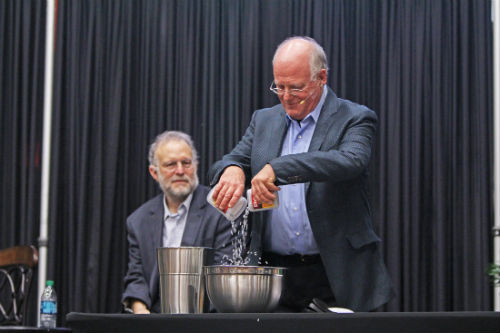
 Ben Cohen, co-founder of Ben & Jerry’s Ice Cream, pours metal BB pellets into a bowl representing how much money businesses give to politics, with each BB representing $600, during last Tuesday’s presentation on the Edinburg campus. Also shown is Jerry Greenfield, co-founder of the Company. Gabriel Mata / The Rider Photos


Ena Capucion
NEWS EDITOR
After Ben Cohen was rejected from medical school twice and Jerry Greenfield failed to graduate with a college degree, the pair didn’t know what to do with their lives. They eventually decided to take a $5 correspondence course from Penn State University on how to make ice cream.
About 750 students, staff and community members attended the second Distinguished Speaker Series of the spring semester last Tuesday on the Edinburg campus. It featured the founders of Ben & Jerry’s Ice Cream, Cohen and Greenfield, who shared their history and business values.
The two grew up in Long Island, N.Y., met during gym class in middle school and remained friends during high school at Sanford H. Calhoun High School. After going their separate ways for college, the two reunited in 1977. Once the pair decided on an ice cream business, Cohen and Greenfield took a course in ice cream making.
Upon completion, the pair decided to relocate to Burlington, Vt., and opened their first Ben & Jerry’s in May 1978 with $12,000. During the summer, Cohen and Greenfield would make nearly 10 batches of ice cream a day.
However, when winter came around, about negative 20 degrees Celsius, business was barren. Cohen came up with an idea that when executed didn’t turn out as planned.
“We came up with what I think is the best marketing promotion in the history of Ben & Jerry’s. It was called … Penny-Off-Per-Celsius-Degree-Below-Zero-Winter-Extravaganza,” Greenfield said. “The way this worked is when the temperature got below freezing, 32 degrees Fahrenheit but zero degrees Celsius, we started taking money off the price of an ice cream cone and the colder it got, the more money we took off the price of a cone. But, not even that was enough to get people in the [parlor]. [So], we got through winter by selling ice cream to some of the local restaurants that [had] been asking for it.”
The pattern continued into the following year, until Cohen decided to become their salesman. He would drive around town during the winter from restaurant to restaurant, then from grocery store to grocery store, selling the duo’s ice cream. By doing this, Ben & Jerry’s made its way into the ice cream manufacturing and distribution business. The ice cream brand was then picked up by big ice cream distributors in Boston and Connecticut. Soon after, two distributors met with Cohen and Greenfield at a restaurant at the Logan Airport in Boston where the men were faced with an issue.
“Häagen-Dazs Ice Cream, which had just been bought by the Pillsbury Corp. had come to them and told [the distributors] that if they continued to carry Ben & Jerry’s on their trucks, they weren’t going to sell them Häagen-Dazs anymore,” Greenfield said. “And as these distributors explained to us, ‘Look, we like you guys, we like your ice cream, but Häagen-Dazs is the most profitable item we carry on our trucks. We can’t afford to be without it. So, we’re going to have to drop your product.’”
To counteract, Cohen and Greenfield considered filing a lawsuit against the $4 billion corporation at the time. The pair also tried to bring the issue to the Federal Trade Commission. However, they were told that the FTC was more interested in helping big companies grow as opposed to helping the smaller companies survive.
Eventually, the duo took their issue to the people through ads and signs on transit buses. Once it gained publicity, several articles on the situation were published by the Wall Street Journal, The New Yorker magazine and the Boston Globe newspaper.
“Because there was so much of a public outcry, Pillsbury and Häagen-Dazs backed down,” Greenfield said. “They allowed these distributors to carry Ben & Jerry’s on their trucks, right next to all the other brands that they carry and that’s what permitted Ben & Jerry’s to eventually be distributed across the country.”
As Ben & Jerry’s grew, the two noticed that they strayed away from the art of ice cream making and conversing with customers, to a business duo that hired and fired people, spoke with accountants and lawyers, and wrote memos and correspondence. Cohen and Greenfield saw themselves caught in the economic machine, so they considered leaving the business. After encouragement from a friend, the duo decided to take a few steps forward to change up the game.
Despite making $2 million in sales, Ben & Jerry’s was still using equipment from World War II and needed an upgrade to maintain consumer demand. Businesses mainly bring their needs and request venture capital. However, Cohen and Greenfield turned toward the community.
They were discouraged by their business advisers because no other business, known globally, has relied on the community for money.
“The way we found to do that was to become the first ever Vermont public stock offer–selling stock in the company to Vermonters, people who have been supporting the business since it started,” Greenfield said. “If we’re going to grow our business, we want to do it in a way that’s consistent with our values.”
About a year later, they made their stocks national and then created the Ben & Jerry’s Foundation, which received 7.5 percent of pre-tax profits from the stocks and sales. The corporate average is about 1.5 percent. The foundation would fund issues that would target hunger as well as housing.
“The reason we chose such a high percentage was that our feeling at the time was that business is essentially a machine for making money,” Greenfield said. “So that if we want to be as of much [a] benefit to the community as possible, we should give away as much money as possible.”
By the year 2000, Unilever, a multinational consumer goods company, made a $325 million offer to buy Ben & Jerry’s from the pair. Cohen and Greenfield reluctantly sold the company to Unilever, which also owns Ragu, Lipton and SlimFast.
“Selling the company was not something we wanted to do,” Greenfield said. “We wanted to stay independent. But, Ben & Jerry’s at the time was a public company, which meant anybody could purchase shares of the company and Unilever offered so much money that the board of directors was not able to find a suitable alternative for the shareholders. So, since that time, we have continued to work at the company, we are employees. We’re not involved in the management or the operations of the company, so we have jobs where we have no responsibility and we also have no authority. So, if you like what’s going on at Ben & Jerry’s, you don’t get to thank us and if you don’t like what’s going [on], you don’t get to blame us either.”
BUSINESS, SOCIETY AND POLITICS
Cohen and Greenfield tried to approach business from a different perspective in order to meet the needs of society. By first looking at the definition of business, the activity of producing a product or providing a service, Ben & Jerry’s took it beyond commerce and concluded that business is the current day’s most powerful force in society. Cohen said that in previous times, religion was the most powerful force, then the government.
“As that most powerful force, business controls our society. It controls our elections, through campaign contributions, it controls our legislations through lobbyists and Congress,” Cohen said. “It controls our media through ownership and it controls our everyday lives as customers and employees.
“And yet, all of that is done in the narrow self-interest of business, and that’s the big difference between today’s most powerful force and those other former most powerful forces because, at least, religion and government had as their purpose to improve the quality of life for the entire society, whereas business has never had that as part of its brief. Even today, most business schools are teaching that the only legitimate purpose of business is to maximize profits.”
Cohen made an analogy that there is a spiritual aspect to business as there is in the lives of individuals.
“As you give, you receive,” Cohen said. “As you help others, you are helped in return. As your business supports the community, the community supports your business. We’re all interconnected. And as we help others, we cannot avoid helping ourselves. These are truths that are written in the Bible, but despite that, it [is met] with incredible resistance in the business world.
“The German philosopher Arthur Schopenhauer wrote about situations like this and said that all truth goes through three stages: First, it is ridiculed; second, it is violently opposed; and third, it is accepted as being self-evident. So, we’re somewhere along that continuum now in relation to how people in our culture see the purpose of business.”
Cohen and Greenfield questioned the reason why people involved in business have a large number of social concerns, but don’t use its power to help improve the quality of life for others. They came up with two observations; the first is the compartmentalization of lives in society and the second is that business has only one thing to measure: profit.
Cohen and Greenfield built Ben & Jerry’s to reflect their personal values that include considering the quality of life in the community. Cohen said if the business fails at either, the business has failed as a whole. At Ben & Jerry’s, they link their money to social purpose and business activities to social benefits to continue the process of innovation.
“We live in a culture where we deal with our social concerns by donating some time or some money to a nonprofit organization. We deal with our spiritual concerns on Saturday and Sunday at church or temple or mosque,” Cohen said. “We deal with our financial needs, most of us, in the world of business. Yet, the reality is that we will never accomplish our spiritual concerns or our social concerns until we integrate them into the form where we as human beings are at our most powerful, which is the form of business. And the second reason why business has not been doing its bit, is the reality that you only get what you measure … [which] is profit. It is that focus on profits that keeps everybody in the business aligned and moving in the same direction, but the other side of the coin is that it disregards the negative fallout of its activities and it misses so many opportunities to integrate social concerns into its activities.”
“When business talks, the politicians listen, the media listens [and] the public listens. But what’s going on today is that many incredibly large, multinational corporations are using that voice only in their own
self-interest.
Ben Cohen
Co-founder of Ben & Jerry’s Ice Cream”
Cohen said the media accused Ben & Jerry’s of performing good deeds to persuade customers into buying their ice cream.
“We replied that the things that our company was doing were based on deeply held values and they were just another integrated and holistic effort to meet another set of our customers’ needs, which was the need to help solve some of the increasing social problems of our day,” he said.
Cohen and Greenfield published a book, “Double Dip: Lead with Your Values and Make Money, Too,” which mentions that the strongest component that businesses have for improving the life in the community is their voice.
“When business talks, the politicians listen, the media listens [and] the public listens,” Cohen said. “But what’s going on today is that many incredibly large, multinational corporations are using that voice only in their own self-interest.”
Cohen closed with a visual demonstration to show how much of the nation donates to politicians. There were several cases of BB pellets and a large tin bowl. Each BB represented $600. First, he demonstrated how much 90 percent of the American public donates to politicians–zero were poured into the bowl. Next, Cohen showed how much the next 9 percent of the American population donated–one BB. The top 1 percent were demonstrated with six BBs. Finally, Cohen demonstrated the average donation to politicians from the top 100 corporations–10,000 BBs, which represent $6 million.
Cohen and Greenfield started a movement, separate from Ben & Jerry’s, to stamp money out of politics. The two created several stamps with different messages such as “Not to be used by bribing politicians” and “Corporations are not people” in hopes of decreasing private funding to politicians. Today, there are about 60,000 stampers across the nation. When an individual stamps a bill, it stays in circulation for about two and a half years. And when a single person stamps three bills a day for an entire year, it will reach one million people.
“What this is about is the idea that numbers of people working together are stronger than dollars–are more powerful than dollars,” Cohen said. “And when you think about it, that’s what every revolution has ever been about. The money interest always has the control, but when people are working together, they’re able to overturn the interest of money.”