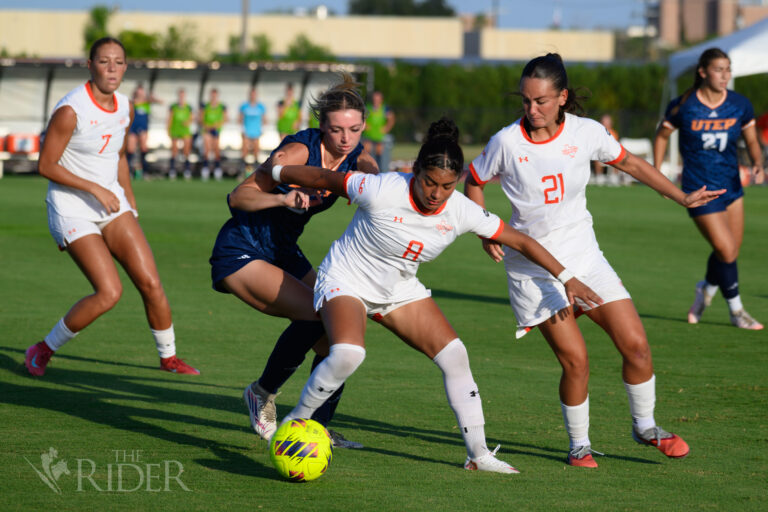
Jose Rodriguez/THE RIDER
The Rider went behind the scenes of UTRGV Athletics to learn more about the art of sports medicine and what is done to help student athletes.
Don Sommer, head football strength and conditioning coach, has a 35-year-long career. Sommer said he spent 12 years at the University of Missouri and 21 years at Texas Christian University and is now aiding the Vaqueros.
“It takes a lot longer to set it up than it takes for them to lift,” Sommer said. “[Strength and conditioning] is an evolving, ever changing process, but the basics are the basics. I mean you push, you pull, you squat, you hinge, you single leg. If you make your program on those five things, it is always going to be solid.”
He said he is old school when it comes to the training and does not follow stuff seen on Instagram nor “jump on a bosu ball and all that B.S.”
His philosophy is going as heavy as you can for as long as you can.
“We’re going to be tough,” Sommer said. “… Our whole goal is to physically beat you up and make you want to quit so the game is easier.”

Shane Venteicher, director of Football Medicine, said the programming for athletes is based on their injury, their mentality, their comfortability and the time of game-season.
“You have to take all that into thought when you’re making a rehab plan and a treatment plan; you just put that all together and you lay it out to the athlete,” Venteicher said. “At the end, we have to make sure each individual person is on board with what you’re laying out there with them.”
He said there is more to life than athletics, and their goal is to make sure they are “at least healthy going on in daily life.”
Venteicher said the better Sommer’s strength and conditioning program is, the easier his job is.
“They do a great job with, like, the strength and conditioning aspect of it,” he said. “Whenever we do have guys come in, it doesn’t matter if it’s just soreness or an injury, we will do some sort of corrective exercise.”
Another strength and conditioning coach to highlight is Dan Park, who trains with women’s basketball, track & field and cross-country.
Park said it is very hard to prevent all injuries.
“Sports are inherently dangerous,” he said. “What we try to do on the strength side is prepare them for all those demands, so that’s why we train them so hard … so, when it is time to get out on the floor or the field, they are as prepared and confident as they need to be.”
Braden Phetkhamchanh, associate athletic trainer for men’s soccer, track & field and cross-country, said the biggest thing for him is to teach people with new injuries or recurring injuries how to take care of themselves.
“[For] a lot of these kids, it’s their first injury that sometimes they don’t know how to deal with,” Phetkhamchanh said. “For me, it is just helping them develop coping strategies to deal with it and work through it and learning that it is not the end of the world if they are not out at practice or out playing. … They just have a little setback.”