Samantha Cantu/THE RIDER
The One Big Beautiful Bill Act, which allocates funds for the construction of a border wall, may affect the National Butterfly Center as the wall may run through protected areas, raising concerns among local residents.
Jeffrey Glassberg, president of the North American Butterfly Association, said the possible construction through the area stems from a shift in federal funding language, under the One Big Beautiful Bill Act, Title IX, 139 STAT. 258.
“This has been going on since 2017,” Glassberg said. “And in that first go around, Congress wrote into the appropriations bill an exemption for the National Butterfly Center. … Apparently, when the appropriations bill was signed last July, the final product didn’t include that exemption. … And so, the federal government now is poised to go forward.”
Per the bill, Congress allocated approximately $46.5 billion for border barrier construction and technology.
Environmental Awareness Club members said the issue reflects a pattern of environmental and community concerns across South Texas.
“[My reaction] was kind of like, ‘This again?’” said Sofia Martinez, the EAC fundraising officer and an environmental science senior. “We’ve already seen this with Santa Ana [National Wildlife Refuge] … and Big Bend [National Park]. … It’s kind of, like, we’ve known that it’s going all around the border.”
Anthony Hoshing, EAC president, said he was “very disappointed” by federal action tied to the funding bill.
“This isn’t gonna help the community,” Hoshing said. “The infrastructure that they’re planning to replace to build this border wall can’t be reproduced in our lifetime.”
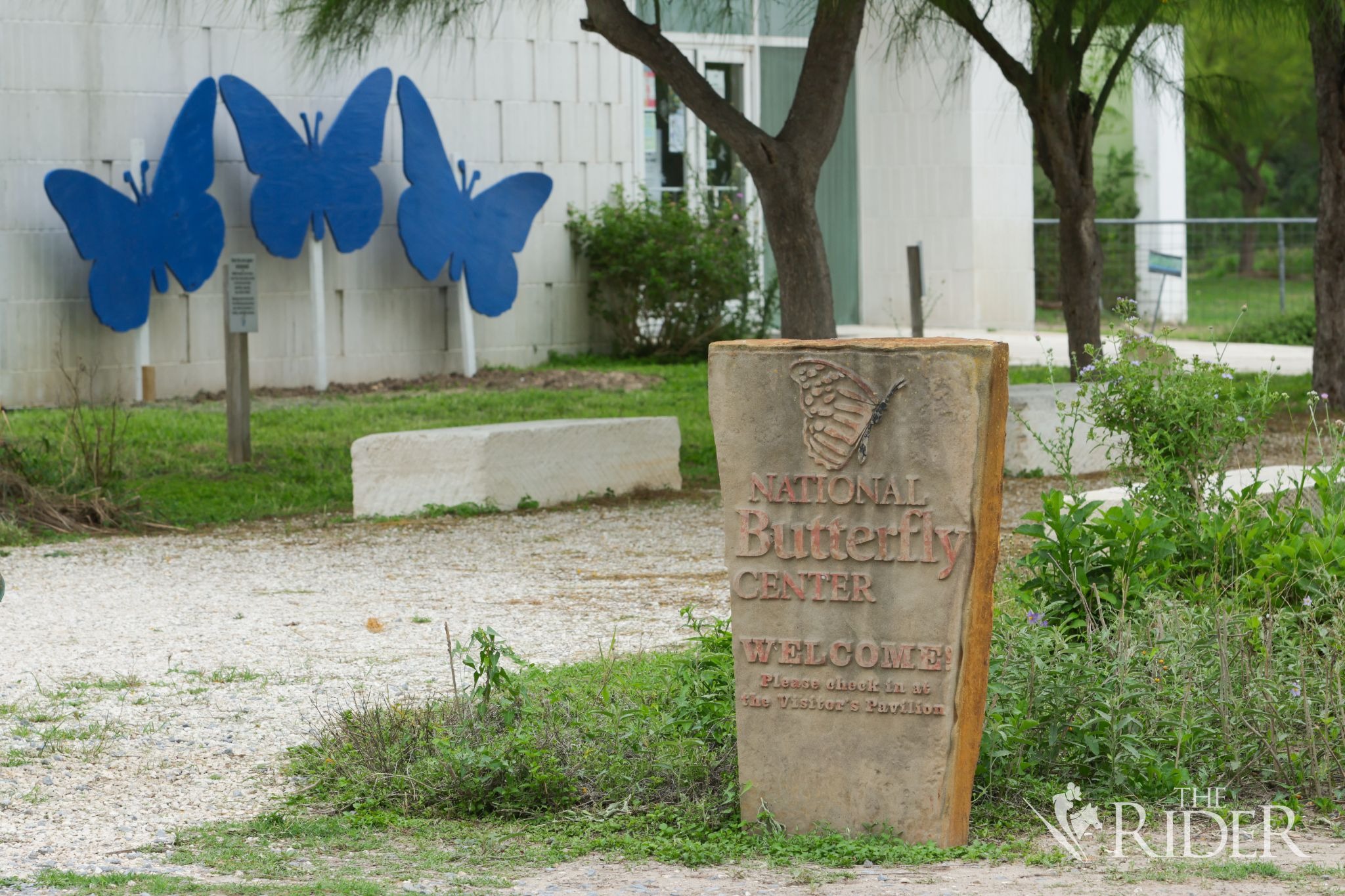
According to Glassberg, in addition to housing over 250 species of butterflies and birds, the center also serves as a community space.
Samantha Cantu/THE RIDER
Vivian Salinas, the EAC co-treasurer officer and an environmental science student, said the loss could affect not only the region’s inhabitants but also the education of future generations.
“This National Butterfly Center really gets youth to care about things like the environment and endangered species,” Salinas said. “I know a lot of people who experience field trips to places like these as kids. … It really starts young.”
Hoshing said the environmental impact could be long-lasting and possibly irreversible and referred to examples of species movement that could be disrupted if national parks stay unprotected, such as the black bear population in Big Bend.
Black bears have crossed the border and repopulated habitats without human intervention, according to a Borderlands Research Institute study.
“That success story could be trifled so easily,” Hoshing said. “This [research] could help us rehabilitate so many [endangered] species and discover their behavior, but what made this such a success would be gone. This [migration] is … unheard of … and we need to study this, but that … opportunity would be lost.”
The club president also commented on the broader environmental effects of construction.
“Adding more steel and concrete to this area will definitely be ugly,” Hoshing said. “… It’s already hot. … Adding more concrete isn’t going to solve that problem.”
Glassberg said the environmental damage would begin once construction starts. Beyond habitat destruction, he said, additional infrastructure and lighting could further disrupt ecosystems and even tourism.
“It immediately destroys the habitat where they’re doing the actual physical construction,” Glassberg said. “All of the plants that live there … and, therefore, all of the animals that are dependent on the plants are also gone from that area.”
U.S. Rep. Monica De La Cruz (R-Edinburg) and Mission Mayor Norie Gonzalez Garza were contacted but, as of press time, were unavailable for comment.
According to Glassberg, the National Butterfly Center has “no problems” with illegal border crossings through its property and feels the construction is “political theater.”
He said he hopes lawmakers will restore protections moving forward.
“They should maintain that status quo … and put into any new appropriations bill that there won’t be a wall through these same areas,” Glassberg said. “Destroying this tremendous asset … for no reason … just seems such a shame.”