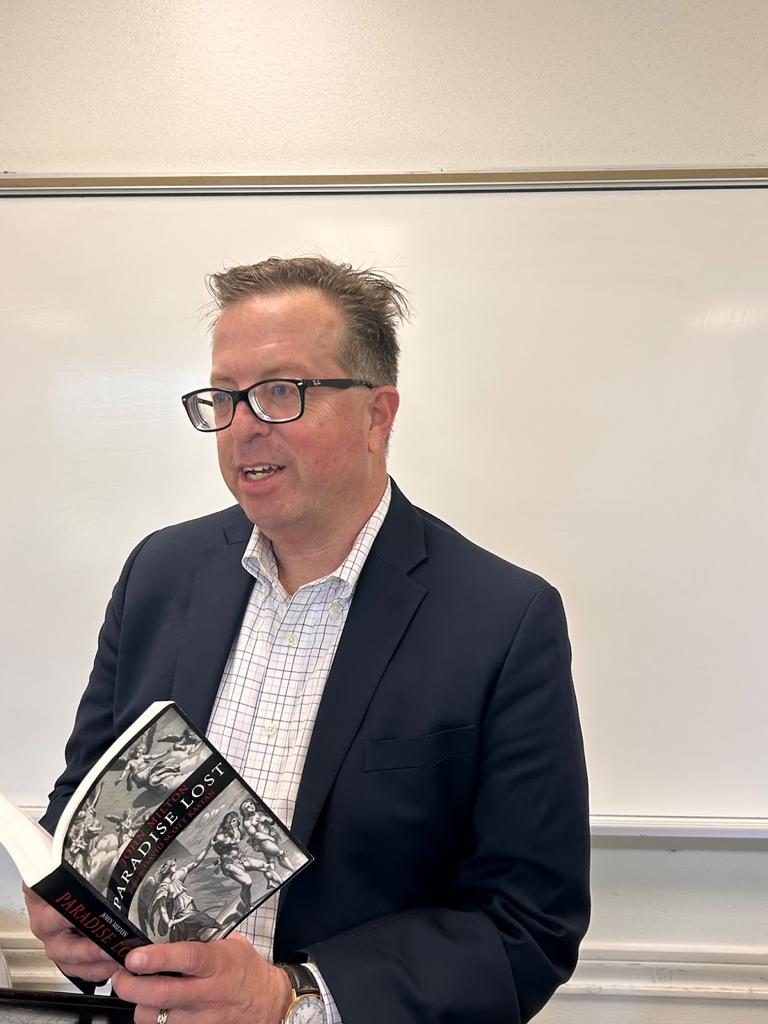
PHOTO COURTESY ANDREW FLECK
For more than 10,000 lines, English poet John Milton’s “Paradise Lost” explores the heights of heaven and the depths of hell. Beginning at 8:30 a.m. Wednesday, those words will fill the Charles and Dorothy Clark Art Gallery in the Liberal Arts Building South on the Edinburg campus as students gather for a “Milton Marathon.”
The event, expected to span roughly 10 to 11 hours, invites the community to immerse themselves in some of the most influential poetry in the English language, according to a UTRGV professor.
The reading of the 17th-century epic poem is organized by Andrew Fleck, a literature and cultural studies professor, who has carried this tradition across multiple universities for a quarter-century.
“The concept behind it is … to take a poem which sounds beautiful and which can be kind of daunting if you kind of just read it on the page and put it out there for the public to enjoy,” Fleck said.
While many encounter Milton through silent study, the professor argues the poem was designed for the ear. Milton, who lost his sight later in life, dictated the epic to aides, the professor said.
“He clearly was hearing it out loud and kind of composing it on some level, also out loud,” Fleck said. “It’s a poem that I think really repays hearing.”
The marathon is designed to be interactive rather than a formal performance.
The professor said participants can listen to the “beautiful words” or, if they feel “brave,” step up to the podium to read a section themselves.
For those unable to commit to the full 10-hour session, the event features a flexible “drop-in” format.
Guests are welcome to stay for the duration or simply stop by for a few minutes to experience the atmosphere.
“People can … drop in for five minutes, drop in for three minutes, and just hear a little Milton,” Fleck said. “If you want to read something, that’d be great.”
The event aims to foster a sense of belonging. In past marathons, Fleck watched as the shared struggle of navigating Milton’s complex syntax brought strangers together.
“I’ve always enjoyed watching,” he said. “… They’ll be sitting there and they’re looking to try to figure out where they’re supposed to be in the poem.
“And the person sitting next to them will be like, ‘Oh, it’s on this page, and it’s on that line,’ and help them kind of find where they go.”
This year’s reading is scheduled intentionally to coincide with the midterm for Fleck’s students, providing them a chance to hear the work in its entirety after weeks of close study.
To complement the auditory experience, the event will feature poster-sized images of famous artistic responses to the poem, including engravings by William Blake, an English poet and painter, and Gustave Doré, a French graphic artist and illustrator.
Fleck said these visuals highlight the poem’s dramatic narrative of rebellion.
Milton, a staunch anti-monarchist, wrote “Paradise Lost” in blank verse—unrhymed iambic pentameter—which he viewed as a rejection of the “chains” of rhyme and an embrace of “English liberty,” according to the professor.
“Homer doesn’t write in rhyme, and Virgil doesn’t write in rhyme,” Fleck said. “Why should the great English poets be writing in rhyme, either?”