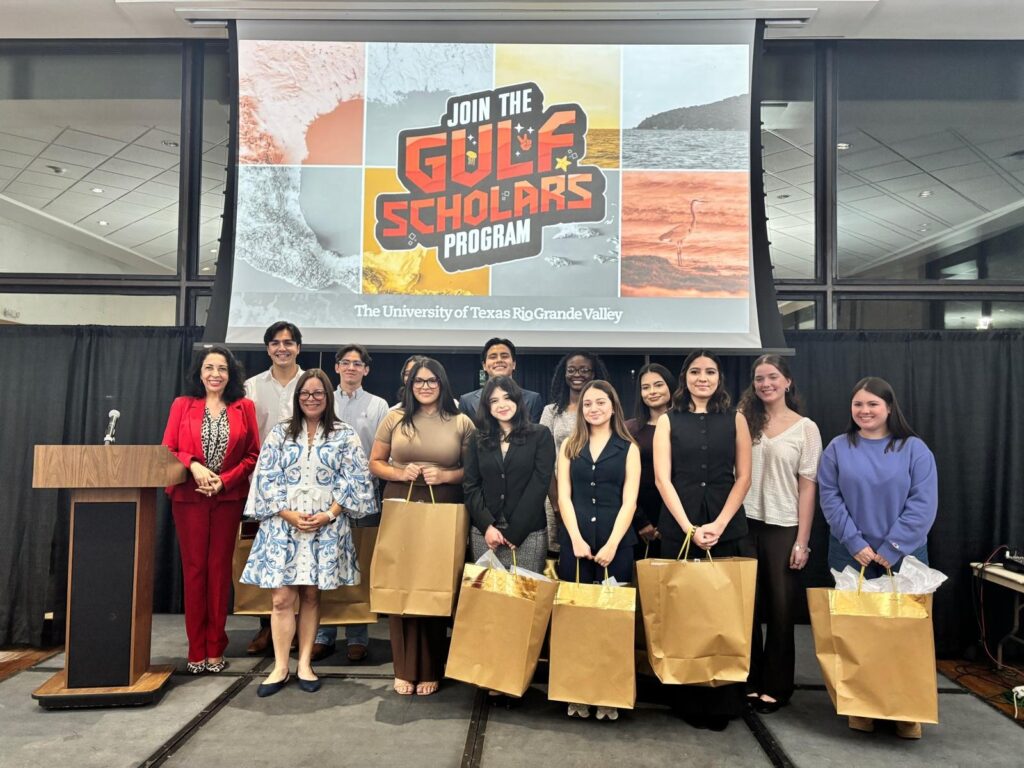
PHOTO COURTESY GULF SCHOLAR PROGRAM
The Gulf Scholars Program at UTRGV begins its first year of research today for Spring 2026, after announcing it in early December.
The university joined the five-year pilot program in 2o24 and was awarded $500,000 from the National Academies of Sciences, Engineering, and Medicine, expanding it to 24 universities across Texas, Louisiana, Mississippi, Alabama and Florida.
The research program aims to prepare undergraduate students to address environmental, energy, health and infrastructure challenges in the Gulf of Mexico region, according to a Nov. 11, 2024, news release.
Marla Perez-Lugo, professor of environmental sociology and co-director of GSP at UTRGV, said the university became part of the 2024 cohort after a written proposal was submitted.
“The NASEM published a call for proposals and my predecessor, Dr. Friederike Bruehoefener, [former director of the School of Interdisciplinary Programs and Community Engagement], decided to submit a proposal, and she contacted me to see if I wanted to write a proposal with her and other members of the starting committee,” Perez-Lugo said.
She added one of the motivations to apply was to expand the School for Interdisciplinary Programs and Community Engagement.
“We had the motivation to bring money for research and for student services, you know,” Perez-Lugo said. “It was a match made in heaven.”
Miranda Hernandez, an environmental science sophomore part of the inaugural cohort, said she came across the program application on social media and decided to apply.
Hernandez added she wants to work in a project related to agriculture while in the program.
“I hold agriculture close to my heart because my dad works as a researcher for agriculture,” she said. “And I find food to be one of the most difficult things to access easily when it comes to farmer needs.”
Jesus Hernandez, an integrated health science sophomore, said he looks forward to learning about the role of food, energy and water in the Gulf region.
“It plays a big part in the lives of the people in the [Rio Grande] Valley,” Jesus Hernandez said. “I would really like to learn how it all works and takes a toll on the people here.”
Perez-Lugo said she hopes students enrolled in the program will have an impact in two ways: being a bridge between UTRGV and the communities around it and developing tools to solve environmental and social environmental problems.
Miranda Hernandez said she looks forward to helping the community through the program.
“I think there’s something very valuable in staying united through hardship and regaining the ability of helping,” she said.
Each year, the students selected will be awarded a $1,500 scholarship, an opportunity to present at the Annual GSP Conference, and a chance to collaborate in the exploration of water, food, and justice issues in the region.
Perez-Lugo said the inaugural cohort will take a course in the spring based on non-governmental organizations and their work in the Gulf region.
“We are asking them to start thinking about what they can do to contribute to the work that these organizations are doing to solve socioecological problems in the region,” she said.
The professor added students will work from developing apps to organizing community partnerships.
“Well, my only comment to the students is to come and join us,” Perez-Lugo said. “It’s fun. It’s hard, but it’s fun. And we are going to be visiting many different organizations.”
Each fall, the program will open applications for students interested to start in the spring semester.
According to Perez-Lugo, the program looks for students with a 3.5 or higher GPA with an interest in the Gulf region, working with non-governmental organizations, interdisciplinary programs and interdisciplinary learning.
Jesus Hernandez added interested students should have other volunteer work to improve their resume before applying.
“I believe that’s something that really stood out for me and the other candidates that we all had similarly was that we all like to dedicate some time to helping the community,” he said. “If they see that you’re really oriented to helping the community, they’ll for sure consider your application.”
Miranda Hernandez said it is important for students interested in applying to know themselves and their passions.
“I honestly would say that just participate, participate in things around yourself that can get you involved somehow, that can let you know more about yourself and, most importantly, have the courage to apply,” she said.