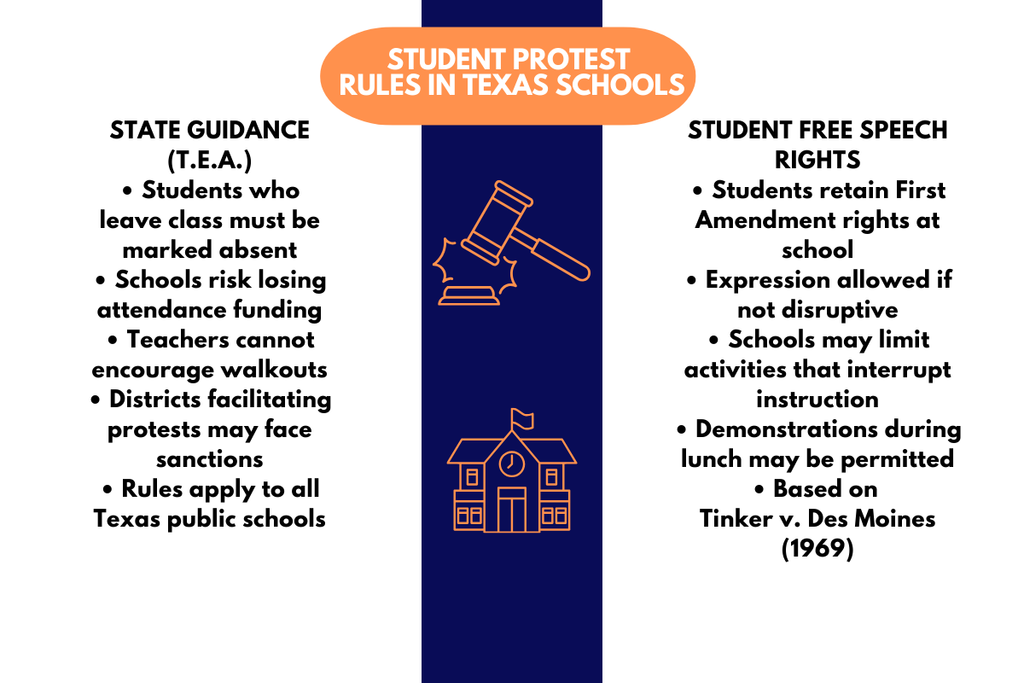
Sources: Texas Education Agency, Brownsville Independent School District, USCOURTS.gov:
Ethan Taylor Maldonado/THE RIDER GRAPHIC
The Texas Education Agency said students who leave class to protest could face disciplinary consequences under statewide guidance issued Feb. 3.
Ken Paxton, the Attorney General of Texas, is investigating the North East Independent School District in San Antonio, the Dallas Independent School District, and the Manor Independent School District for “facilitating and failing to keep students safe and accountable during various student protests against lawful immigration enforcement,” according to a Feb. 16 news release.
The Rider reached out to the Edinburg Consolidated Independent School District Feb. 20 for comment regarding the Feb. 6 walkout in Robert Vela High School. Lisa Ayala, ECISD director of Public Relations and Media Communications, said the district did not issue a press release but mentioned two students were suspended for one day for their participation in the protest.
The Brownsville Independent School District confirmed student gatherings occurred Feb. 6 at several early college high school campuses during scheduled lunch periods, according to a Feb. 9 news release from the district’s Office of Public Relations and Community Engagement.
Most students returned to class afterward, and instruction continued without significant disruption, the district stated.
Students who did not return to their scheduled classes after lunch were marked absent in accordance with district policy, according to the release.
The district emphasized student expression is protected under Tinker v. Des Moines, which allows schools to regulate speech only if it substantially disrupts the learning environment.
“Students do not relinquish their constitutional right to free speech and expression when they are at school,” said Douglas M. Brattebo, an assistant professor of constitutional law in UTRGV’s School of Political Science, Public Affairs, Legal and Security Studies.
Brattebo said the ruling permits schools to limit demonstrations that interfere with instruction or the rights of others.
“As long as student expression does not significantly disrupt the educational enterprise or infringe on the rights of others, school administrators cannot compel the students involved in protests to desist,” he said.
However, Brattebo said large walkouts during class time can present challenges for schools.
“Legally speaking, a broad student walkout from school might make it challenging for an educational enterprise to carry on productively,” he said, adding administrators may impose attendance penalties on students who leave class.
State guidance reflects those concerns. TEA said schools risk losing attendance-based funding if students are not marked absent after leaving class, and educators who encourage walkouts may face disciplinary action, including possible loss of certification, according to the Feb. 3 news release.
Districts found to be facilitating demonstrations could be subject to state oversight, including the appointment of a monitor, conservator or board of managers.
The agency also said state law prohibits school systems from supporting or opposing political activism that disrupts instruction during the school day, including through the use of district resources.
Brownsville ISD said it remains committed to maintaining a safe and respectful learning environment while ensuring instruction continues without disruption.
Officials have not reported additional large-scale demonstrations at district campuses, according to the release, but policies would apply to any future protests during instructional time.