


PHOTO COURTESY UTRGV NEWSROOM
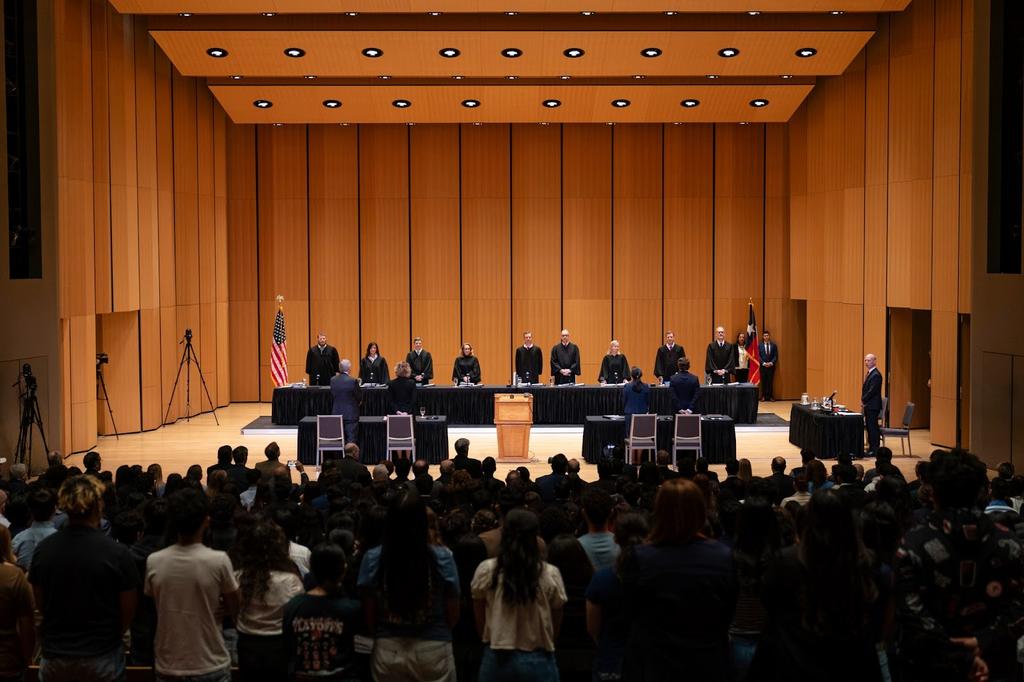
The Supreme Court of Texas heard oral arguments regarding a lawsuit challenging a Texas law Thursday in the UTRGV Performing Arts Complex on the Edinburg campus.
The cases, consolidated for one oral argument (SaveRGV v. Texas General Land Office, SaveRGV v. Cameron County and Ken Paxton v. SaveRGV), challenged House Bill 2623, which amended Texas Natural Resources Code § 61.132 to allow temporary beach closures for spaceflight activities.
The SaveRGV, Sierra Club and the Carrizo/Comecrudo Nation of Texas argue the law violates Article I, Section 33 of the Texas Constitution, which guarantees public access to beaches, while state officials contend the closures are a lawful public-safety measure.
After the Cameron County District Court dismissed the lawsuit, the dispute reached the Texas Thirteenth Court of Appeals, which allowed the lawsuit to move forward, prompting Ken Paxton to appeal to the Supreme Court of Texas.
During Thursday’s hearing, attorneys for the petitioners and the respondents presented arguments about whether the lawsuit should be allowed to proceed and their interpretations of precedents and Texas law relevant to the cases.
“The open beaches amendment to the Texas Constitution does not guarantee every person access to every Gulf Coast beach at all times,” said Beth Klusmann, an attorney representing the petitioners, during her opening statement.
Klusmann continued her argument by challenging if the petitioner’s claim held merit.
“If the claim was going to fail as a matter of law, then it is facially invalid,” she said. “If the claim is going to fail, there is no reason to waste additional resources defending it.”
After Klusmann’s arguments, James P. Allison, an attorney also representing the petitioners, came up to the stage to interpret Section 33, Subsection D of Article I of the Texas Constitution.
“[The open beaches amendment] does not create a private right of enforcement,” Allison said. “Therefore, they reserved the right of enforcement to public entities.”
Marisa Perales, an attorney for the respondents, argued the closures violate the constitutional guarantee of public beach access.
“When the government closes the beach under its HB 2623 authority, it does so at the request of SpaceX, so that SpaceX can take possession of the beach, exclude the public from it, and use it as its blast zone for its spaceflight activities,” Perales said.
Much of the discussion focused on whether the plaintiffs have legal standing to bring the lawsuit and whether the Open Beaches Amendment allows private individuals or organizations to challenge beach closures in court.
Justin Katusak, a part-time lecturer in political science, said oral arguments allow the justices to question attorneys directly about the legal issues raised in a case.
“This is the highest court of last resort in Texas, and the justices will hear arguments about whether the case should move forward,” Katusak said.
He said the justice’s decision will come at a later date.
“There will be a written opinion that comes after,” Katusak said.
The lecturer said if the court rules the plaintiffs do have standing, the case can return to the Cameron County district court for further proceedings. If the court rules otherwise, the case can be dismissed.
A student attending the hearing said the event provided a rare opportunity to see the state’s highest court in action.
“I think it’s amazing, not only for [UTRGV] but for students in general,” said Ian Alfaro, vice president of external affairs for the UTRGV Student Government Association. “They get to come and see the Supreme Court, and I really like how they opened the floor up for questions and gave students a chance to participate.”
–Stephen Gutierrez contributed to this story.
