PHOTO COURTESY JULIAN GARCIA
The UTRGV Speech and Hearing Center, located in Health Affairs Building West Room 1.206 on the Edinburg campus, is expanding its services this spring with the launch of a Voice and Swallowing Specialty Clinic, aimed at addressing voice and swallowing disorders.
The clinic, led by Clinical Assistant Professor Julian Garcia, offers specialized evaluations and treatment for issues such as chronic hoarseness, vocal fatigue, throat tightness and difficulty swallowing. Garcia is a board-certified specialist in swallowing disorders and has advanced training in voice evaluation through previous work with UTRGV’s ear, nose and throat specialists.
“One thing I felt that we were lacking was treating voice and swallowing disorders,” he said. “[The Speech and Hearing Center] serves any kind of issue that a student might be having in the realm of speech pathology or communication. But the specialization in the [voice and swallowing] areas is kind of limited, so people are usually looking for answers and don’t have anyone to provide for them.”
According to Ruth Crutchfield, chair of the Communication Sciences and Disorders program, the new specialty clinic shows effort to broaden the center’s reach.

PHOTO COURTESY JULIAN GARCIA
“We’ve been moving to create new programs, so we can provide services to different groups of people,” Crutchfield said. “This clinic was the creation of Mr. Garcia. He has a unique interest in the function of the voice, and he wanted to provide an opportunity for individuals who needed help.”
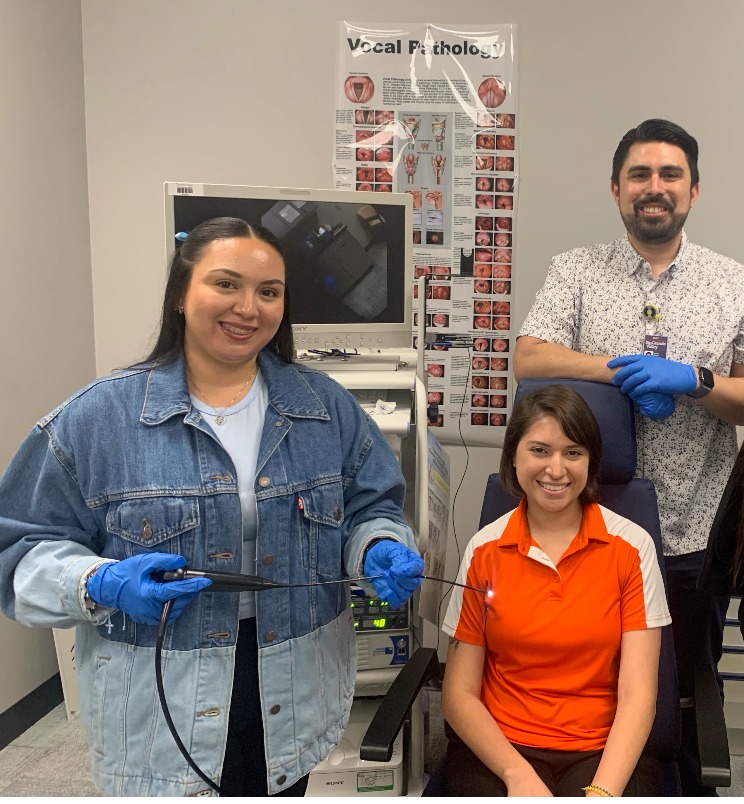
Both researchers said one of the clinic’s key features is instrumental and endoscopic evaluation, a procedure that allows clinicians to visualize the vocal folds and throat using a small camera passed through the nose. The evaluation helps identify issues such as inflammation, vocal fold weakness, nodules or movement asymmetries that may not be detectable through external examination alone.
“[People come in] because they notice repeated voice loss or hoarseness,” Crutchfield said. “That means something might be happening, so that’s when you should look into finding out.”
Garcia said many cases involve irritation caused by acid reflux, which can inflame delicate throat tissues and lead to chronic symptoms. In those cases, treatment often focuses on education, vocal hygiene and dietary changes, though some patients may be referred to a specialist for further medical evaluation.
The clinic currently focuses on serving UTRGV faculty and staff, particularly those who rely heavily on their voices. Students are also welcome to seek services. Evaluations are offered for a reduced fee as the center operates as a functional clinic and does not accept insurance.
In addition to patient care, the clinic provides valuable learning opportunities for graduate students in the speech-language pathology program. Students observe evaluations, assist with assessments and gain exposure to the medical side of the profession.
Garcia said he hopes to eventually expand the clinic’s services to the wider Rio Grande Valley community, though capacity is currently limited by staffing and scheduling constraints.
“[The clinic] is something we want to build slowly, but eventually be able to offer it to the community,” he said. “We’re trying to spread awareness and provide a service that’s not common here.”
Those interested in scheduling an evaluation can contact Garcia at julian.garcia04@utrgv.edu.