

 Felipe Zamorano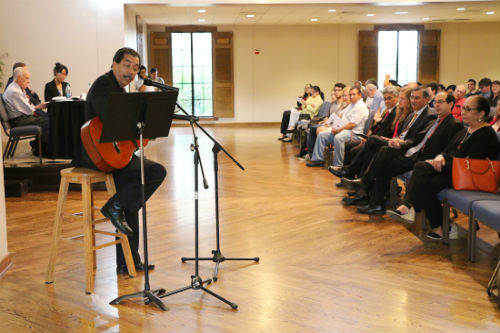
[metaslider id=4452]
Felipe Zamorano
THE RIDER
“Don Américo knew it was not his job to tell the public what they wanted to hear. Rather, he knew it was his charge and responsibility as a cultural creative scholar to hold culture, in its various forms, accountable for practices of injustice, inequality and misrepresentation.”
Those words by Noreen Rivera, an assistant professor of literatures and cultural studies and Mexican American Studies faculty affiliate at UTRGV, highlight Paredes’ unrestricted commentary on the Mexican American experience.
UTRGV’s Mexican American Studies program and UT Austin’s Center for Mexican American Studies jointly hosted “A Texas-Mexican Centennial: The Legacies of Américo Paredes” on Wednesday at the Plains Capital Bank El Gran Salón on the Brownsville Campus.
The celebration was an homage to Paredes, a musician, scholar, author, folklorist and a Brownsville native who went on to have an accomplished career as a professor in the University of Texas at Austin. He received numerous honors including the Charles Frankel Prize from the National Endowment for the Humanities, awarded for outstanding contributions to the public’s understanding of the humanities, and the Order of the Aztec Eagle, the highest honor given to foreign citizens by the Mexican government for services given to Mexico or humankind.
Among his works are “With His Pistol in His Hand: A Border Ballad and Its Hero,” “George Washington Gomez: A Mexico-Texan Novel” and “Between Two Worlds.”
“He’s about validating who we are,” said Richard Flores, a professor of anthropology and senior associate dean of UT Austin’s College of Liberal Arts. “He’s about showing the nuance and the diversity of who we are and celebrating that.”
Paredes died in 1999.
The event, which was attended by over 150 people, opened with a welcoming speech by Walter Diaz, dean of UTRGV’s College of Liberal Arts. Diaz lauded Paredes’ type of scholarship as one “which doesn’t merely extract knowledge … for the benefit of the scholar. ”
“Rather … [it is one] where the scholars work with the community to produce knowledge that not only benefits them but also directly benefits and empowers the community,” he said.
The event’s coordinators, UTRGV’s Marci McMahon, an associate professor of literatures and cultural studies and Mexican American Studies faculty affiliate, and UT Austin’s John Morán González, an associate professor of English and associate director of the Center for Mexican American Studies, delivered some introductory remarks in which they acknowledged Paredes’ influence on and contributions to the field of Mexican American studies.
“The field of Mexican American and Chicano studies, and in turn the scholars that have been nurtured and mentored within those fields are really part of the living legacy of Paredes,” McMahon said.
Additionally, McMahon highlighted the growth of the Mexican American Studies program and listed some of its milestones, including an increased number of undergraduate and graduate courses, as well as a new offering of a Mexican American studies course for Brownsville Early College High School students.
In his keynote speech following the opening remarks, Flores explained the significance of a line in the last letter Paredes sent to him.
“He closed with a shakily scribbled ‘P.S.’ that states simply, ‘Sorry for the typos,’” Flores said. “On the first read, it struck me as odd.”
“His apology for typos, I now understand,” he said. “There is little room for error. Scholars … cannot afford to misplace words, nor miss the key. Incisiveness of mind, clarity of word: the politics of the pen. This is Paredes’ legacy.”
He said Paredes’ lessons of honor and integrity of work are what he wants to celebrate.
“While it’s been nearly 60 years … the lessons of [his] texts are no less important,” Flores said. “The need for honor and integrity remain, and, in fact, are perhaps more necessary than ever.”
After the keynote speech, a panel composed of Rolando Hinojosa-Smith, the Ellen Clayton Garwood Centennial Professor in Creative Writing at UT Austin and friend of Américo Paredes; Rivera; and Jamie Starling, an assistant professor at UTRGV’s History department who substituted for history Lecturer Manuel Medrano, detailed Paredes’ life and the importance of his work.
Closing remarks noting the influence the scholar has had on their academic career were delivered by UTRGV graduate students Victoria Valdez, Martha Garza and Abel Moreno.
“If you really dug into his scholarship, it’s universal,” Moreno said.
“He was beyond his years in the way he thought about the Mexican American culture and what it really meant to everybody,” he said. “[Paredes believed] that the people in this community belong to something greater, something he termed ‘The Greater Mexico.’”
The celebration concluded with a performance by José Villarreal of the corridos “La Adelita,” “El Corrido de Gregorio Cortez” and “El Mayor De Los Dorados.”
During the reception following the celebration, Los Halcones Del Valle also performed corridos.
About The Author
