
PHOTO COURTESY AMANDA RODRIGUEZ
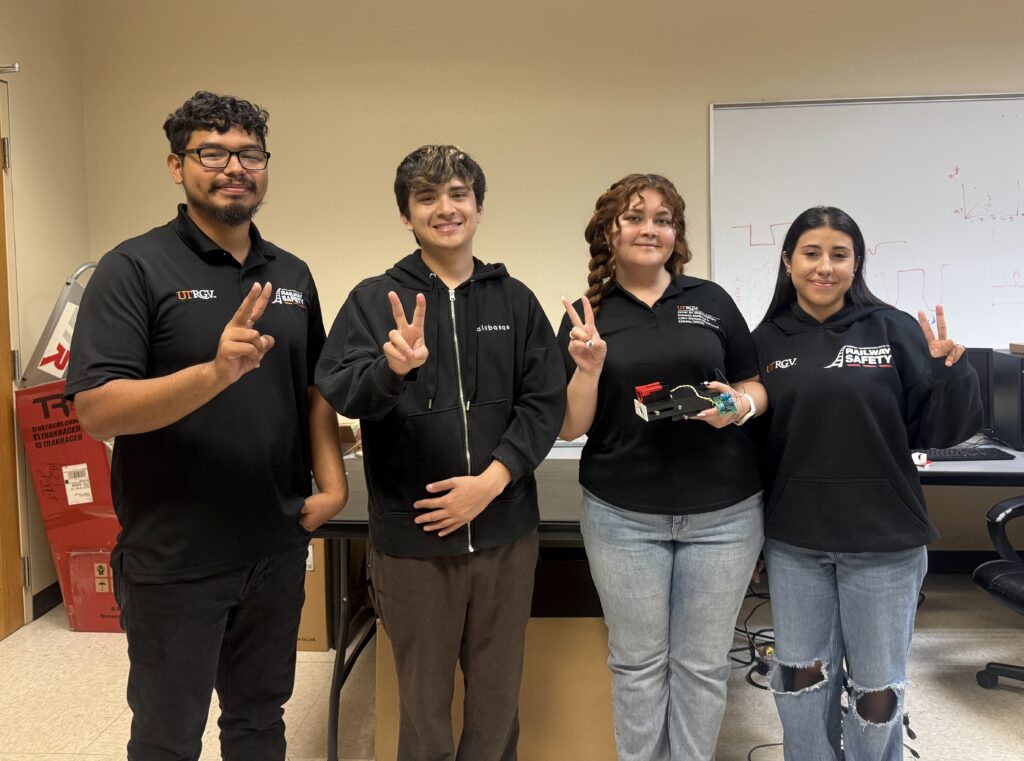
Students are developing a nanoparticle-based sensor designed to detect cracks in bridges without physical contact, potentially improving infrastructure safety and reducing risks for inspection workers.
The project, which has been in development for the past five years, uses laser technology and nanoparticles to identify structural defects. Researchers are currently testing the sensor on plastic samples and are transitioning to concrete, but it has not yet been tested on bridges.
Constantine Tarawneh, senior associate dean for research and graduate programs and mechanical engineer professor, said the project was developed through UTRGV’s National Science Foundation funded the Center for Multidisciplinary Research in Physical Infrastructure. It is part of a $5 million grant supporting research involving artificial intelligence, sensors and automation.
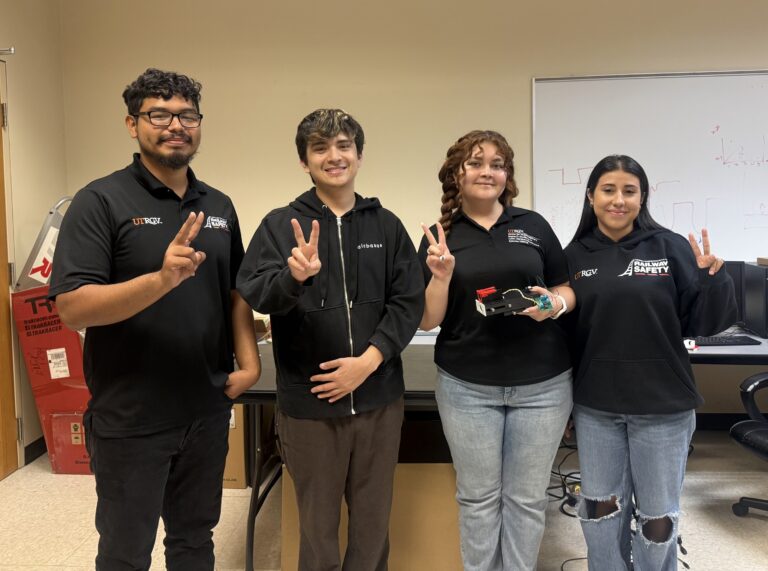
Amanda Rodriguez, an electrical engineering graduate student and research student, said the project focuses on developing new nondestructive testing methods to address bridge deterioration.
“I think it’s just mainly finding new ways for new nondestructive testing methods, because one of the biggest concerns we have is bridge degradation,” Rodriguez said.
She explained the nanoparticle-based sensors consist of two components: an emitter and a receiver. The emitter directs a laser toward a surface, while the receiver collects reflected light and converts it into an electrical signal.
According to Rodriguez, when a laser encounters a crack, the light scatters, causing a change in voltage that researchers can use to identify structural defects.
“Our main limitation is the sun,” Rodriguez said.
She said the sun can interfere with the sensor’s measurements, so the researchers have implemented a filter to reduce interference but continue to work to improve the sensor’s accuracy.
Rodriguez said traditional bridge inspections often require workers to physically examine structures which can be dangerous.
“What we wanted to do was create a way that … didn’t need a person to go out into the field,” she said.
Jinghao Yang, Roderguez’s master’s supervisor, said researchers are also exploring potential applications for manufacturing quality assessments and other infrastructures.
Tarawneh said the next phase is integrating the technology into a drone which could eventually conduct routine inspections and monitor whether existing cracks are expanding.
He added the university has submitted a patent application for the technology and hopes to commercialize the sensor.
Yang said the project involves collaboration among students and faculty from multiple disciplines, including electrical engineering, mechanical engineering and computer science.
Rodriguez said the technology could benefit the Rio Grande Valley by improving bridge maintenance and preventing structural failures.
“I think it’d be a great way to keep them safe, right, for the community to be able to maintain them just so that we don’t have to risk any kind of failure,” she said.
About The Author