
Gael Espinoza/THE RIDER
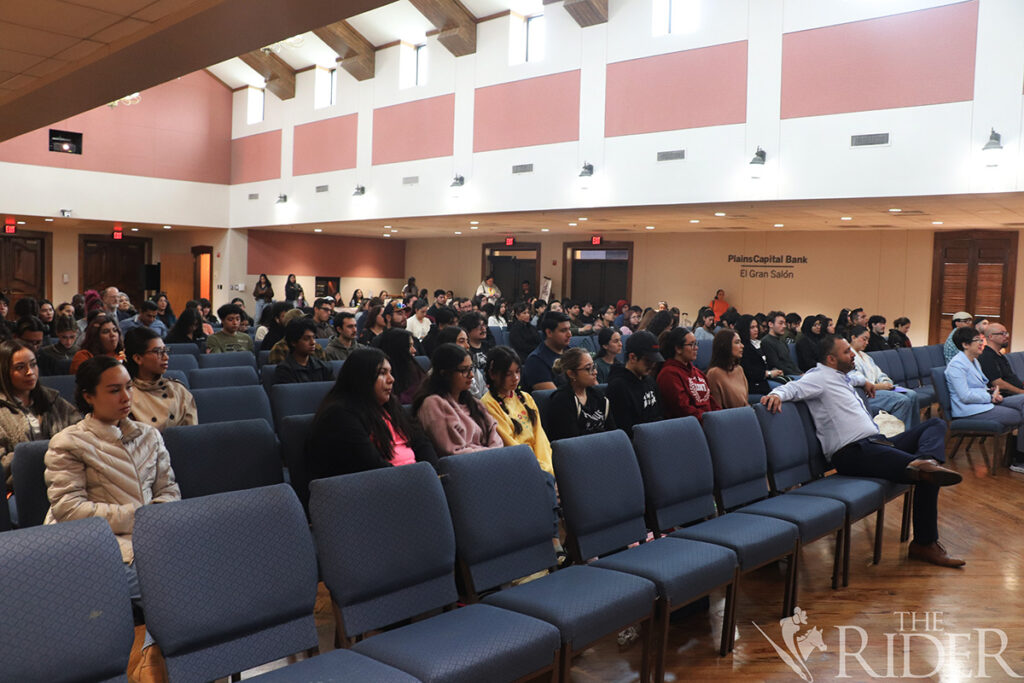
UTRGV Robert C. Vackar College of Business & Entrepreneurship and other departments and organizations hosted a moderated panel discussion called Vackar TalkX Nov. 16 from noon to 2 p.m. at the PlainsCapital Bank El Gran Salón on the Brownsville campus. The panel, with a turnout of 145 students, invited industry professionals from Microsoft and UTRGV to share insights on how artificial intelligence is changing the workplace.
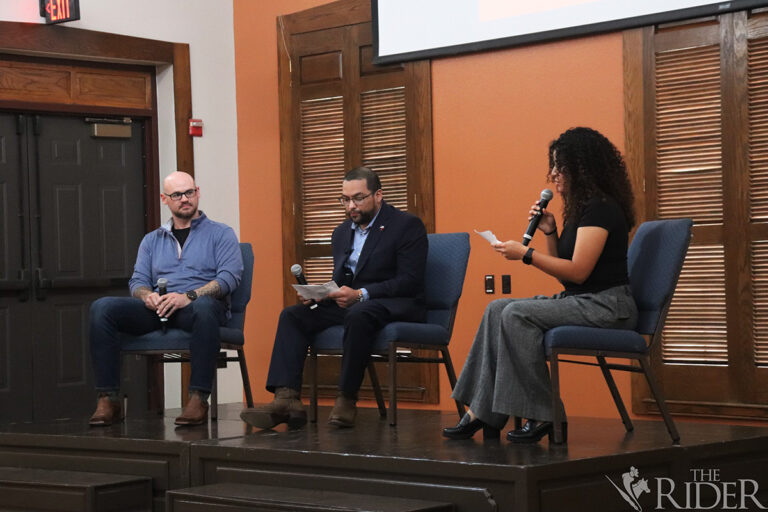
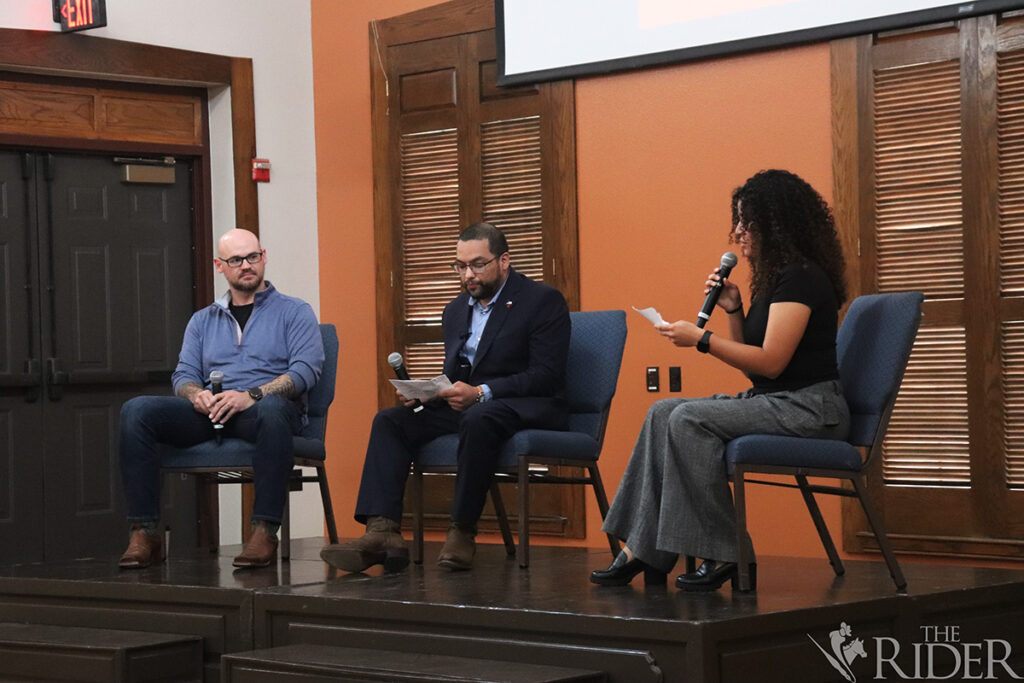
The invited speakers were John Cottle, director of data and AI for Microsoft; Michael Jabbour, AI innovation officer for Microsoft; and Eric Martinez, the assistant director of business intelligence and enterprise engineering for the UTRGV School of Medicine.
The panel discussion was led by Rebecca Green, an English writing and biological sciences senior, who asked questions to the guest speakers for them to share their perspectives on AI in the workforce.
During the panel, Martinez said he believed AI could be used as a tool for opportunity and entrepreneurship. He explained how small business owners and entrepreneurs can use AI tools to validate ideas, conduct market research and create business prototypes.
“You can just generate prototypes of all of these things overnight and play out the entire life cycle of an entrepreneur,” he said.
Martinez said while AI can easily replicate information, it can also be cloned by anyone else. He emphasized AI can replicate products and ideas, but a person’s competitive advantage comes from their creativity and understanding of community rather than technical capabilities.
Gael Espinoza/THE RIDER
Cottle shared his own insight, stating while AI can be used to replicate and generate anything for anyone, it is important to consider how it could benefit society.
“Whenever we’re using AI or creating tools with AI, we have to have that social permissibility aspect,” Cottle said. “… It needs to benefit somebody. It needs to have a good outcome.”
Throughout the panel, Martinez and Cottle talked about how students could use AI tools to get ahead in their careers, encouraging students to do research as to how AI will impact their fields and what opportunities they can find in it.
Regarding the impact AI could have on the Rio Grande Valley, both speakers said AI as a tool can create “generational wealth” by allowing residents to develop business and solutions that are tailored to local needs.
“Use your lived experience and translating that with the power of a tool, like, AI is a thing that can take you out of a place and bring you into generational wealth,” Martinez said.
Jabbour joined the panel virtually where he introduced himself and his position in Microsoft, stating his primary role is not just to build machines, but rather to create machines that can help “solve the world’s greatest problems.”
He said to students to be responsible with AI and use it as a learning tool to better develop themselves, rather than a tool to answer for them.
“I love that you’re able to think before you ask. Because if you don’t, the AI’s thinking will become your thinking,” Jabbour said.
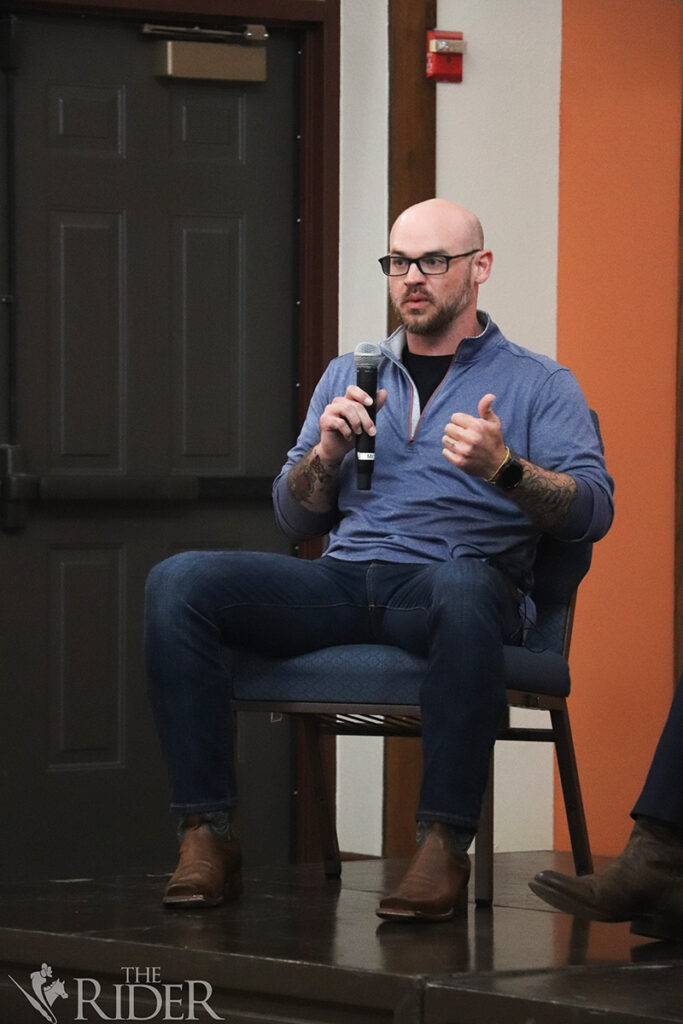
Gael Espinoza/THE RIDER
The panel was also organized by Information Systems, Center for Innovation and Commercialization, Career Center, Vackar Office of Involvement & Center for Engagement, Information Technology Students of America Brownsville, Association of Management and Organizational Resources and the Pre-Physician Assistant Society on Brownsville campus.
Sarah Saenz, a graduate student of science in business analytics and AI, said her reason for coming to the Vackar TalkX was because the event aligned with what she was studying and to support the ITSA-BTX chapter.
“It makes me really happy to see that ITSA Brownsville is actually holding events like these and getting great turnouts,” Saenz said.
In an interview after the panel, Cottle said his advice to UTRGV students planning to pursue careers in AI and tech would be to use any free tools or resources available and build a skill set from them.
“Learn how to prompt, learn how to identify what is slop versus what is not,” Cottle said. “Identify what people want to see from AI and be able to understand what impact you want to bring as opposed to AI telling you what it wants.”
Regarding students hesitant or worried about AI in the workforce, Cottle said change is common during technological or industrial revolutions. He advised students to approach changes like AI with an open mind, take advantage of opportunities and get ahead.
Erick Lanza, a master’s business administration student with a specialization in business analytics and president of ITSA-BTX, said the event was important for UTRGV students as it gave everyone an opportunity to talk and become informed over AI along with opening opportunities for students and faculty.
About The Author