Ethan T. Maldonado
 Professors say immigration crackdowns, inflation concerns shaped 2025


President Donald Trump’s first year back in office reshaped immigration, the economy and daily life in the Rio Grande Valley as federal policy shifts brought new uncertainty for mixed-status families, small businesses and local workers, UTRGV professors say.
Nearly 11 months into the administration, immigration enforcement, tariffs and an expanded use of executive power have defined 2025, according to La Unión del Pueblo Entero and UTRGV faculty.
An advocate from a local organization said the most immediate effect of Trump’s return has been a surge in fear among immigrant families. LUPE, an organization founded in 1989 by American labor leaders and civil rights activists Cesar E. Chavez and Dolores Huerta, reported changes in how residents navigate work, school and public spaces.
“The biggest change we’ve seen in the Valley this year is a deep culture of fear,” said Dani Marrero, deputy director of LUPE. “Immigration agencies like [Immigration and Customs Enforcement] and Border Patrol are operating with more power under Trump, and people feel that every day.”
Marrero said families who have lived with years of state-level crackdowns now feel even more vulnerable under renewed federal enforcement.
“In conservative states like Texas, we already lived under years of anti-immigrant policies and border militarization,” she said. “The Trump administration has now emboldened all of that.”
Marrero said LUPE has seen families avoid routine activities because they fear detentions as previous notions that immigration enforcement prioritized people with criminal records have “largely disappeared.”
“There used to be a sense that people with criminal records were prioritized for detention; that’s gone,” she said. “People feel that due process and legal protections don’t matter anymore because immigration officials are acting so rogue.”
To support families, LUPE expanded “Know Your Rights” sessions and emergency-planning workshops, which help parents prepare for detentions or deportations.
“We tell families to have a plan: Who will pick up the kids? Who has their documents? And what will happen to the home or car?” Marrero said. “People are living with more stress and uncertainty than last year.”
Beyond enforcement, the administration entered office with a more organized and aggressive strategy than in 2017, according to Mark Kaswan, professor of political science at UTRGV.
“It’s night and day,” Kaswan said. “The first administration was marked by inexperience and confusion. This time, they came in like a bulldozer after years of planning.”
The professor said Trump’s team arrived with a defined agenda to reshape federal agencies, strengthen presidential authority and redirect foreign policy.
“The deepest and most-lasting effect of this administration may be a broad distrust of government,” Kaswan said.
He added the return of large-scale tariffs, shifts in foreign alliances and efforts to centralize executive power will carry long-term implications as the country enters a major election year.
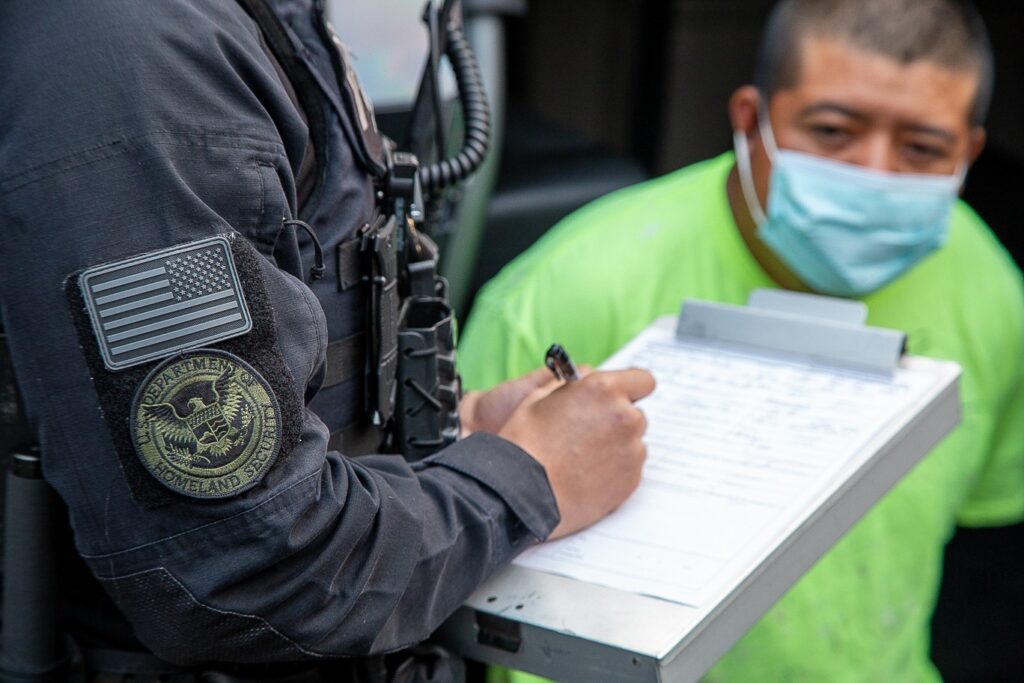
PHOTO COURTESY U.S. IMMIGRATION AND CUSTOMS ENFORCEMENT
While immigration dominated local concerns, 2025’s economic landscape was shaped by tariffs, inflation and a cooling national job market, said Gautam Hazarika, chair of UTRGV’s Economics Department.
“The results this year are mixed,” Hazarika said. “Unemployment remains low, around 4.5%, but the job market is weakening. Inflation is persistently high, and the cost of living is the top worry for Americans.”
He said tariffs remain the administration’s most consequential economic policy.
“Tariffs are having the largest impact,” Hazarika said. “They’re hurting small businesses in particular because so many of them rely on imported merchandise.”
Those costs, the department chair said, ultimately fall on consumers.
“Importers pay the tariff, not foreign companies, and those costs get passed on to American consumers,” Hazarika said. “Tariffs haven’t hit households as hard as expected yet, but economists believe the costs are inevitably going to be passed on.”
He said immigration enforcement also affects the labor market, especially in the Valley.
“Immigration crackdowns absolutely affect the economy, especially in sectors like agriculture and construction,” Hazarika said. “Even legal immigrants may fear being targeted, making it harder for employers to find workers.”
Yet, the Rio Grande Valley, he said, is outperforming the nation.
“We’re seeing a mini-boom driven by companies like SpaceX and the businesses that support them,” Hazarika said. “Our employment is growing at about 4.2% a year and wages at around 7.9%. Home values are rising quickly as more workers move into the region.”
Despite that growth, the Valley remains vulnerable to federal trade policy.
“Because our economy relies heavily on trade with Mexico, tariffs on Mexican goods negatively impact our businesses,” Hazarika said. “If tariffs persist, they will be a long-term drag on the Valley’s economy.”
With a volatile economic picture, deepening fear among immigrant communities and a more assertive federal government, Marrero said LUPE expects next year to be another defining moment, especially as the nation prepares for major elections.
“Administrations and laws come and go, but organizations like LUPE remain because of our members and our community,” she said. “That’s how we withstand attacks from the state and federal government.”
Kaswan said the political environment will continue to evolve as Congress and the courts respond to presidential authority.
Hazarika said uncertainty itself is one of the most significant economic risks.
“The president’s style of policymaking creates uncertainty,” he said. “Businesses dislike uncertainty because it makes it harder to predict returns on investment.”
Readers can find more information about tariffs on the World Trade Organization website.
About The Author