

Mariajose Garza/THE RIDER
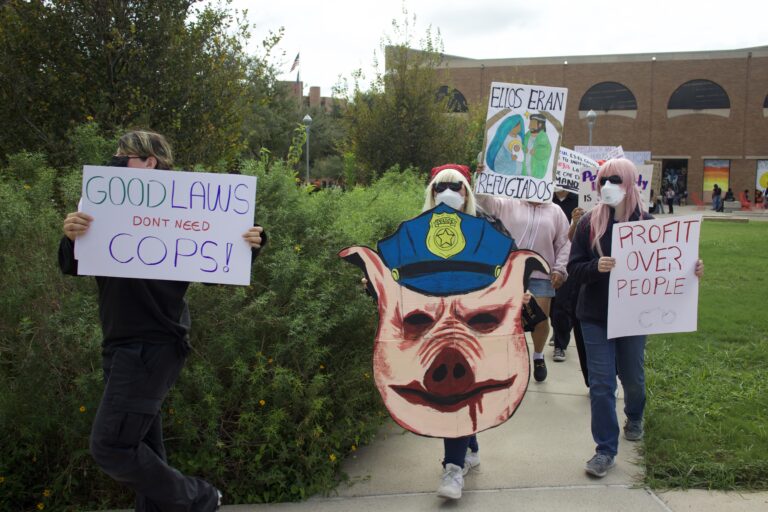
The Macehual Art Collective originated from a pivotal moment of tension: a student walkout at UTRGV on the Brownsville campus earlier this spring.
During the protest, three students who had previously only briefly encountered each other in the art building hallways discovered a shared purpose.
Bilingual education junior Gael Garcia-Gonzalez and art education senior Nicole Logan said they were particularly influenced by the remarks of studio art sophomore Karol Rodriguez.
In an interview, Rodriguez recalled a strong desire to address the national political climate at the protest.
Through a speech he recited there, he encouraged his peers to engage in activism beyond the classroom by educating each other about their fundamental rights.
This speech served as a catalyst for the formation of the collective.
“I think the energy brought us together,” Logan said. “I think the speeches, like Karol’s, united us and, by the end, we recognized our shared commitment to the same cause.”
The shared commitment resulted in “Remnants of the River,” the inaugural exhibition by the Macehual collective. The exhibition will open with a reception at 6 p.m. Tuesday in the Texas Southmost College Rusteberg Art Gallery in Brownsville.
The collective’s name carries historical significance; “Macehual” is a Nahuatl term that, according to Garcia-Gonzalez, refers to the commoner class.
For the group, the exhibition serves as both an “offering and an affirmation,” reminding viewers of the struggles and enduring rights of the people.
Although the work subtly engages with the current political landscape, Rodriguez said the artistic practice takes precedence over political themes.
“The artist expresses this through their work in the way they know best, through their artistry,” he said.
The display works as an act of reclamation, exploring identity and the resilience of the Rio Grande Valley, a region the collective intentionally refers to as “Delta.”
“‘Delta’ just keeps us more in touch with our roots,” Garcia-Gonzalez said.
“Remnants of the River” employs the Rio Grande as a symbol of cultural memory.

Mariajose Garza/THE RIDER
“We used the river as a metaphor,” Garcia-Gonzalez said. “For cultural continuity and, as a way that our culture flows and continues to flow … the water was here before us, so we always return to it.”
The connection to the land is tangible with the exhibition featuring multidisciplinary works, including ceramic pieces created from clay sourced directly from the soil of Port Isabel.
Rodriguez said the inspiration emerged after he attended a ceramics convention, where he learned that 80% of the world uses natural clay, while only 20%, including the United States, relies on processed material.
“It makes the work significantly more meaningful,” Rodriguez said of using regional clay.
The group said they traveled to a ridge in Port Isabel to excavate the wild clay by hand and walked away with five buckets.
“We did not know what we were getting into; we realized how demanding the process is,” Rodriguez said. “But it was rewarding.”
Logan said she believes this direct, physical connection to the soil is central to the exhibition.
“It is significant that we have pieces made with local clay because it directly addresses the themes we are exploring in this exhibition,” she said. “[The work] discusses family memory, the experience of being on this land, and the ongoing developments in the community and the narratives being shared.”
For the Macehual Art Collective, “Remnants of the River” represents its launch pad.
The group is already planning a zine to sustain the momentum and aims to bridge the gap between fine art and community activism.
“We want to remind our community that there is something beautiful here,” Logan said, “and that, at the end of the day, we have each other.”
To learn more about the collective, visit @Mace.hual on Instagram.

PHOTO COURTESY GAEL GARCIA-GONZALEZ
About The Author