Eduardo Escamilla/THE RIDER
From the intimate setting of a regional nonprofit to the high-stakes world of a commercial New York gallery, curator and artist Frances Jakubek has approached the exhibition process not just as a logistical task, but as an act of empathetic stewardship.
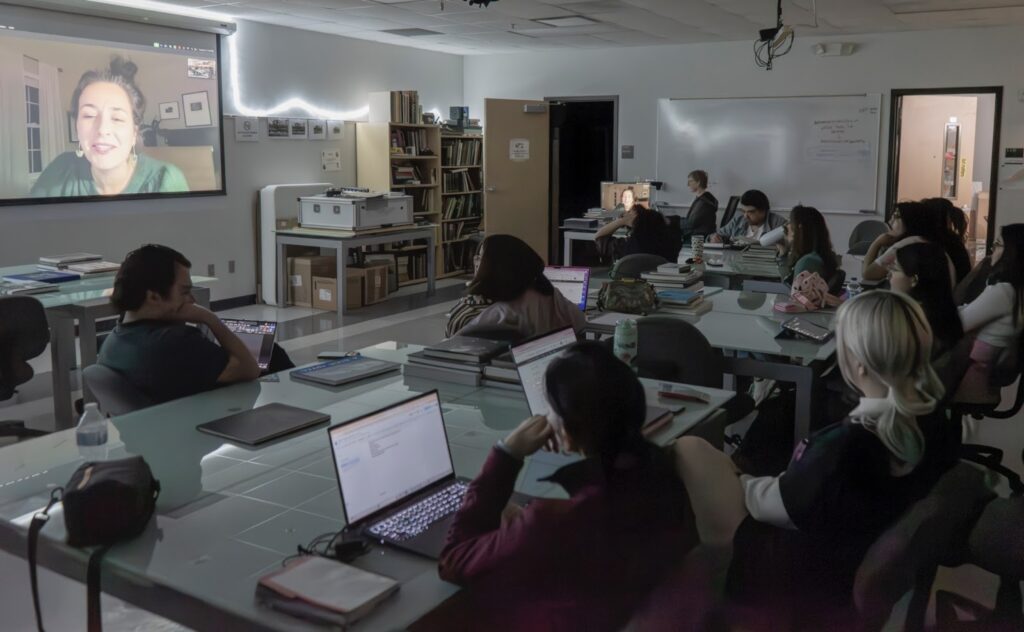
Jakubek has spent her career immersed in the delicate but demanding mechanics of bringing art into public view and, in the presentation Crafting your Exhibition Proposal Tuesday in the Visual Arts Building on the Edinburg campus, she offered a distillation of her experience to students.
The presentation included advice on how a project is framed, its presentation, language and organization, profoundly shapes how an audience will ultimately perceive it.
She anchored her philosophy in a line from John Berger’s “Ways of Seeing”: “The way we see things is affected by what we know and what we believe.”
“How we frame and communicate a project shapes how others will see it,” Jakubek said.
She added the physical presentation of artwork is far from a mere logistical decision, it is a conceptual choice.
The artist used the installations of Wolfgang Tillmans as an example, whose rejection of traditional framing, using pins and tape for prints of varying sizes, transforms the gallery into an extension of the studio.
“His installations remind us that presentation is not just logistical, it’s very conceptual,” Jakubek said.
The work’s scale, density and rhythm become integral to the message, according to the speaker.
She presented several approaches to visual storytelling, including the linear, sequential rhythm of uniform framing, like the work of Rudy Burckhardt; the overwhelming, relational power of large grids, as seen in the work of Rosalind Fox Solomon; and the site-specific flexibility of durable vinyl banners in children’s museums, which allowed Nancy Richards Farese’s work to be accessible to young viewers.
Drawing from artists such as Sophie Calle and Laia Abril, Jakubek stressed the importance of integrating text and image.
The written narrative, she said, can function as an “extension of the gaze” or create a moment for quiet reflection, transforming a purely visual encounter into sustained engagement.
The practical core of Jakubek’s presentation focused on how to translate creative intention into a concrete, professional proposal.
She advises artists to think of their proposal as a comprehensive “package” that anticipates every institutional need.
Jakubek said the statement of intent is an accessible summary of the exhibition’s concept, materials and overall goal: the what and how of the physical show.
The artist’s statement, conversely, allows for more personal voice and emotional context, explaining the why of the practice.
She encouraged the need for rigorous tracking, a “checklist of works,” including size, year, materials and insurance value, often organized in a sortable format such as Google Sheets.
The transparency, Jakubek added, makes it easier for institutions to commit.
She said when submitting to a venue, artists should research the space using online resources and create detailed mock-ups.
This step ensures the proposal conveys the visual intention and physical reality of the show within the gallery’s unique architecture.
Jakubek offered advice to aspiring curators, “Start doing it.”
Taking initiative to organize an independent show, building a reputation through action and a clear voice is the essential first step to establishing oneself in the field.