Mariajose Garza/THE RIDER
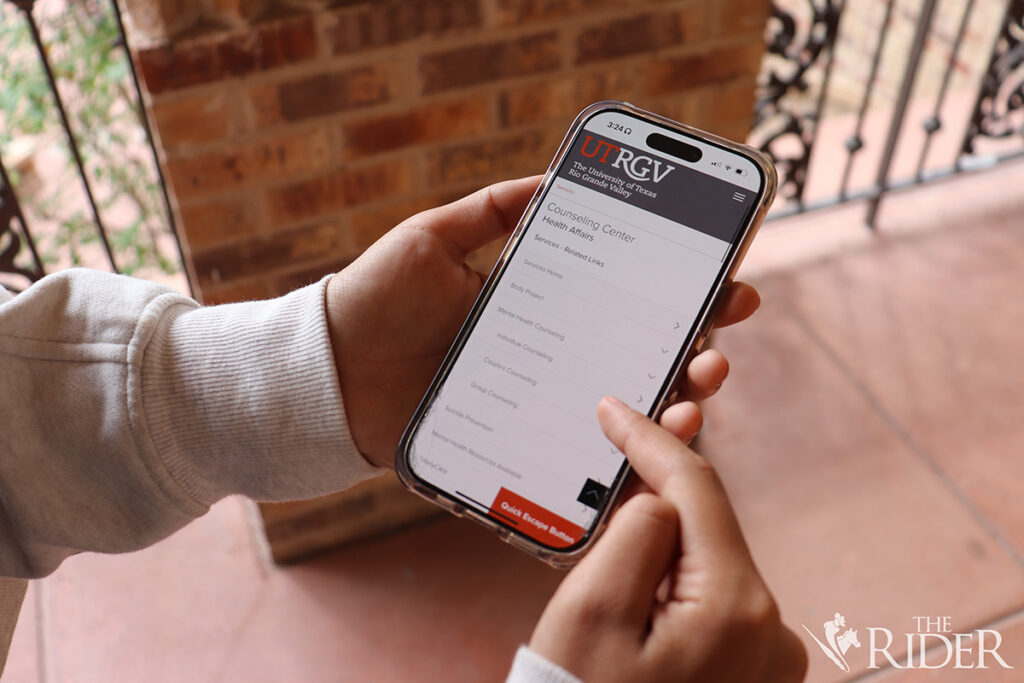
The UTRGV Counseling Center offers free and confidential mental health services ranging from individual sessions to workshops, all of which ensure confidentiality and a secure location to discuss, reflect and seek help.
Case manager for the Counseling Center Diana Landero explained “the services are only available for UTRGV enrolled students, meaning that they have to be taking classes currently or have been continuously enrolled.”
Landero said her role also includes connecting with students’ needs and additional resources on campus and in the community.
“If the counselor does not have rapidly available information, they refer them to me and I help to follow up with the student, and everything is individual,” she said.
The Counseling Center offers services from 8 a.m. to 5 p.m. Monday through Friday in Student Union Room 2.10 on the Brownsville campus and in University Center Room 109 on the Edinburg campus.
According to the case manager, services are usually busy, and do not offer same-day appointments and, for these situations, they offer alternatives in times of distress.
“We have another option called Timely Care and this is a platform, specifically for college students, and this is online therapy that the students can access for free,” Landero said.
Christopher Albert, director for the Counseling Center, detailed the on-demand therapy available for students.
“It’s also a peer-community option where students can communicate with other students across the nation in regards to wellness and mental health matters; this also includes online content they can access,” Albert said.
Students can also access Vaquero Crisis Lines available 24/7, a phone line to help students during an emotional crisis.
Leah Ellis, clinical therapist for the Counseling Center, told The Rider about what a typical therapy session looks like.
“We always start with a screening session,” Ellis said. “Those are about 20 to 30 minutes long. In that session, we do things like we explain confidentiality, so it’s about the privacy of the student.”
She said students are asked what their environment at the moment looks like, how are they sleeping, if they work, what the environment is like, and primarily ask them why they have decided to attend a counseling session.
Ellis said during individual sessions, which take 45 minutes, students can learn the resources available and what they can do to follow up with their mental health journey, such as group sessions, individual sessions or workshops.
“It’s been studied groups can be just as an effective a form of treatment as the individual,” she said. “It just depends on what the issue is. We want to match the student with what best meets their needs.”
The clinical therapist encouraged students to continue with their counseling journey.
“[Students] didn’t come for a while because they were nervous,” Ellis said. “I mean, I would just say, students usually feel so much better after they actually come because they see that it’s pretty comfortable.” For more information, visit the Counseling Center social media @utrgvcounselingcenter or its website.