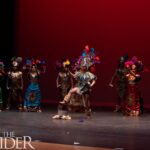
Photographer and director Penny De Los Santos presents her work involving commercial and cultural visuals she has taken over the years Wednesday in the University Library on the Edinburg campus.
Jose Rodriguez/THE RIDER
In the age of pervasive digital culture, where artificial intelligence increasingly blurs the line between genuine and generated imagery, a recent roundtable discussion brought three photographers together to explore how a photograph can still reveal the human condition.
The Center for Latin American Arts hosted Photography As Catalyst Wednesday in the University Library on the Edinburg campus.
The conversation featured Mexican American visual storyteller and award-winning, internationally published photographer Penny De Los Santos.
In addition, associate professor DM Witman and assistant professor Romeo Di Loreto, for the School of Art and Design, each offered a distinct perspective on reclaiming authenticity in their practices.
The main takeaway was clear, the future of photography lies in the intentionality of the artist and the undeniable power of the physical object.
For De Los Santos, a Brooklyn-based photographer with an established commercial practice, authenticity is rooted in a decade spent working with National Geographic and documenting culture.
De Los Santos shared her life’s work has been an obsession with the “American hyphenated” experience, and she spoke of the rigorous process required to honor a subject’s story by gaining access, earning trust and securing consent.
The dedication to narrative truth, she argued, is more essential than ever.
“I do think original photography is still going to be very important,” De Los Santos said, noting the growing “hunger for authenticity” in a world where AI-generated images are already prevalent in commercial campaigns.
Her goal, she explained, is to find the “sweet spot” where a personal passion, like documenting nuanced moments shared within Mexican American communities, can intersect with a sustainable commercial career.
While De Los Santos said she finds her truth in narrative and place, Di Loreto, a native of Italy now based in Brownsville, searches for it through “silence.”
His projects, including “On Silence, (Silenzio),” center on the idea of the border not merely as a physical line, but as an emotional, pedagogical and social threshold.
Di Loreto said he draws inspiration from Roland Barthes’ concept of the punctum—the personal, emotional wound that pierces the viewer—and uses visual subtraction in the landscape to achieve what he calls a sense of “fullness.”
He said his photographs seek not to erase the border, but to “reveal it, to show what it holds, where it hurts, and where it might finally open.”
In this space of silence, Di Loreto said he finds the anima, or soul, of his work sometimes printing images extremely small to force a close, emotional connection with the viewer.
During the discussion Witman said she merges the meticulous practice of a scientist with the expressive language of an artist, frequently addressing environmental crises and the concept of ecologies and transitions and creating unique objects that serve as both “memories and data.”
Witman emphasized the importance of the handmade object as a bulwark against the digital tide.
For her project “Melt,” which documents historic Winter Olympics sites at risk of disappearance due to climate change, she used the 19th-century process of salted paper photography as a method of communicating the ephemerality and fragility of our environment.
Recent work has utilized salt crystals as a metaphor for both mourning and healing, according to the artist.
Her pieces, which are often large and object-like, are unique records that she has used to encourage community engagement, such as through interactive walls where museum visitors share their feelings about the challenging topics addressed, according to Witman.
The three artists, diverse in their approaches—from documentary to minimal to interdisciplinary science—are united by a singular focus: The artist’s perspective, rooted in authentic engagement and physical creation, is the last and most critical differentiator in an image-saturated world.
They advocate for a path in art that favors “the marathon over the sprint,” as Witman described, where the personal background and deep interests of the artist are what ultimately propels the work forward.