



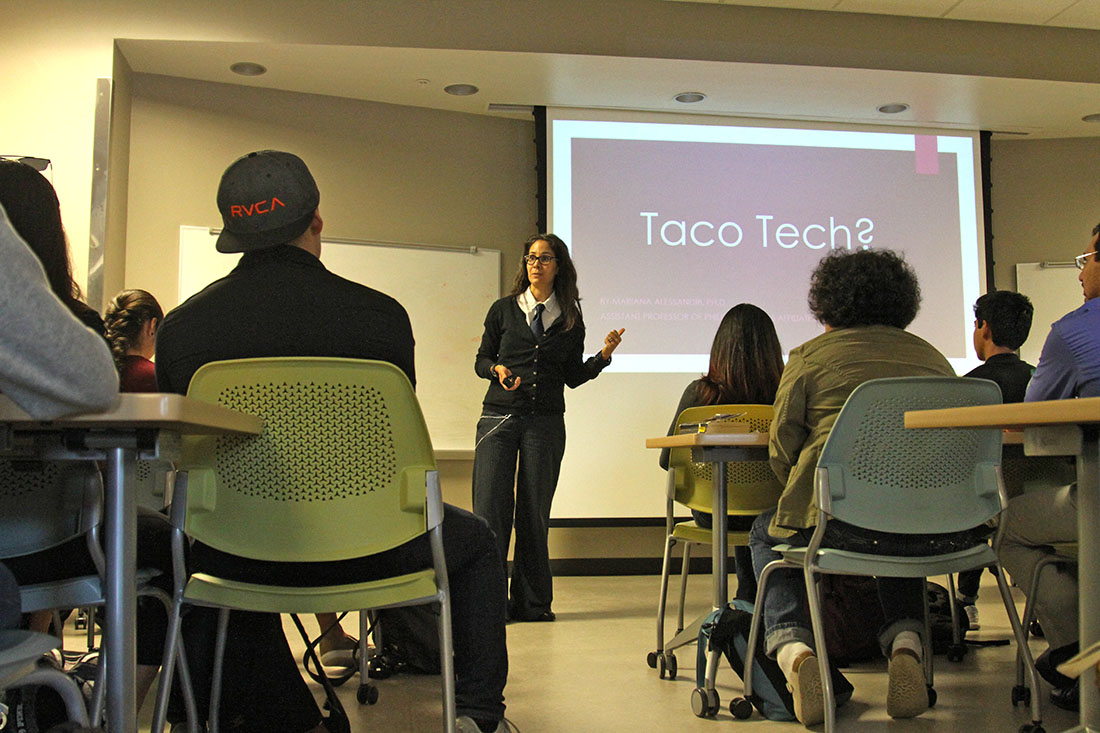
Assistant Professor Mariana Alessandri speaks to students about the Mexican-American identity at UTRGV on Nov. 17 in Edinburg. LESLEY ROBLES/THE RIDER
Mariana Alessandri, a UTRGV assistant professor of philosophy, will present a lecture on the difference between being educated and educado, titled “Educated but not Educado,” at 12:15 p.m. Tuesday in Liberal Arts Building North 101 on the Edinburg campus.
The definition of education in the Merriam-Webster dictionary is “Having an education: having an education beyond the average.” But to Alessandri, educated, in her own definition, is the word used when referring to people going through formal education.
“I think ‘educated’ is the word that we use when we’re referring to people going through formal education,” Alessandri said.
“It has a whole history in terms of Latin American people that rhymes with civilization, so education and civilization were thought to be the same thing and it means pulling you out of illiteracy and making you literate, therefore, making you a better person,” she said.
On the other hand, Alessandri’s definition of educado is something that doesn’t require formal education.
“In Spanish, it means personal values and politeness,” she said. “So, if you’re a polite person, you treat people well, you’re educado.”
Parents and grandparents tell their children to better themselves by getting educated, but in Alessandri’s opinion, education doesn’t necessarily mean being a better person.
She explained that a person with no formal education who grew up with respect and personal values is better than a person who acquired a degree in a university with a 4.0 GPA but could have cheated throughout college to get it.
In her presentation, she will talk about the rules of college and how they don’t contribute to being a better person in the future.
There are unspoken rules in school, especially universities, that some professors take seriously. These rules can be as simple as using correct grammar, sending an email and learning to place a comma in the right place.
“There are things that you have to know and that teachers expect you to know, but they don’t always tell you what those are,” she said.
Students tend to think that they’re stupid and bad people because they think their parents and teachers will be disappointed in them when they don’t follow these unspoken rules, sending the wrong message to them.
Learning the rules of grammar and writing an email professionally doesn’t make a person better but it will definitely help getting a white-collar job.
“So becoming better is a personal thing, it’s not better than an uneducated person,” she said.
Alessandri has had experiences in which professors act offended when students don’t follow the unspoken rules when, in her opinion, it should just be a matter of “Oh, these are some things that you might not know because you’re a first-generation college student.”
“Learning the rules of grammar doesn’t make you a better person, it just makes you a better writer in English, that’s all,” she said.
There’s a preference for people who are professional versus people who are uneducated. Professionals look a certain way and Alessandri wants students to learn what it means to look professional.
“What I want to impress upon students is that they do have to learn the rules of the game because the world will believe that you’re professional if you address the teacher as ‘Doctor’ rather than ‘Miss,’” she said. “… Be strategic: You need to know where the apostrophe goes because the stupid world will think you’re smart if you know where the apostrophe goes and it won’t think you’re smart if you don’t know where it goes.”
Alessandri’s presentation will last about an hour and 15 minutes and will include student engagement. For more information about the lecture, email mariana.alessandri@utrgv.edu.

