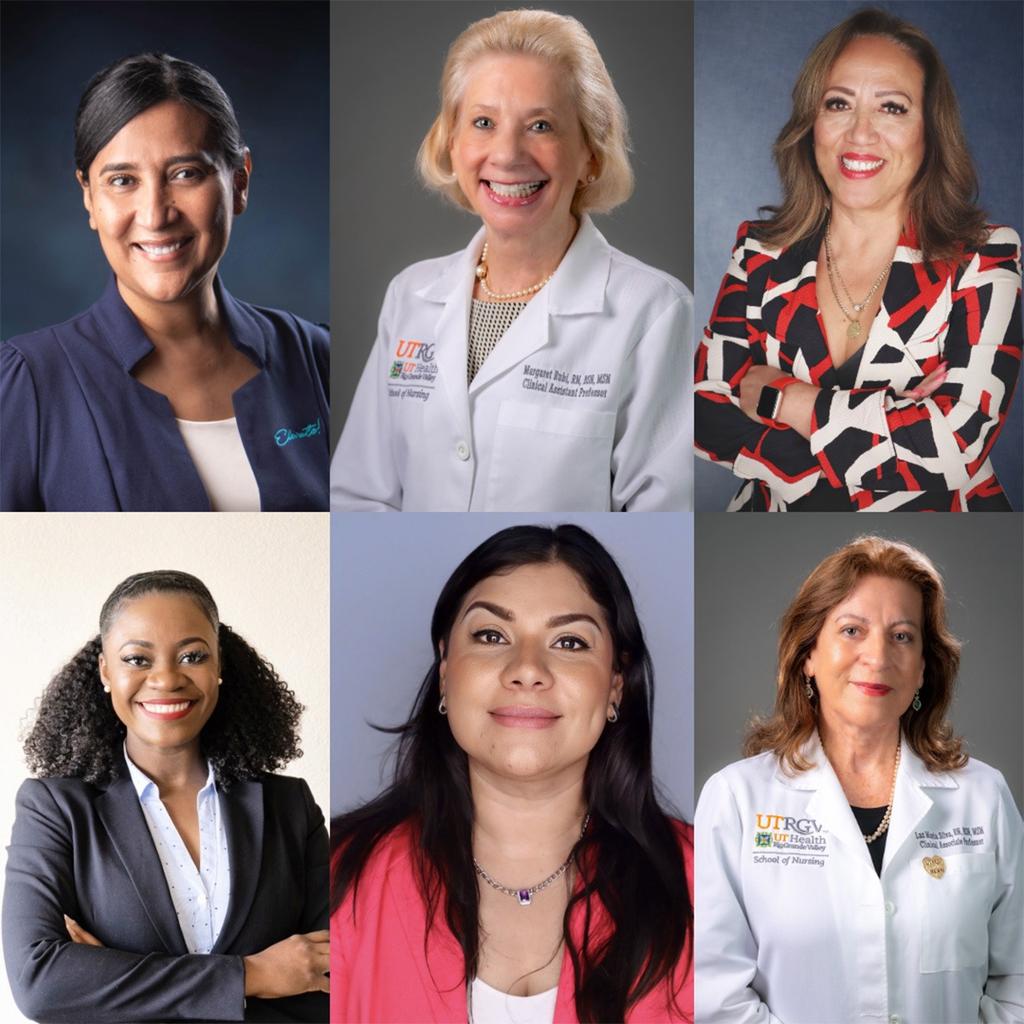
Shown are the Women’s Faculty Network’s executive team. Ruth Crutchfield (from top left), Edinburg member at Large and a professor in the College of Health Professions; Margaret Rubí, chair of the WFN and a clinical assistant professor in the School of Nursing; Leticia Rangel-Chavez, chair-elect and a lecturer in the University College; Naomie Jean, Harlingen member at Large and an assistant professor in the School of Podiatric Medicine; Edna Orozco, past chair and a lecturer in the College of Engineering and Computer Science; and Luz Maria Silva, a Brownsville member at Large and a clinical associate professor in the School of Nursing.
The Women’s Faculty Network at UTRGV continues its mission since 2012 of supporting faculty and staff by creating a space where women can connect and advance their careers, according to Edna Orozco, the network’s past chair and a lecturer in the College of Engineering and Computer Science.
The network has the goal of promoting the development of faculty at UTRGV with activities, workshops and discussion groups, giving them the space to connect, collaborate, and support each other’s growth in leadership and scholarship, according to its website.
The WFN started through a National Science Foundation Advance grant of $3.1 million awarded to legacy institution the University of Texas–Pan American, according to Orozco.
However, the network’s future may be uncertain following the recent dissolution of the university’s faculty senate, a change that could affect the structure and support systems tied to the network, according to Margaret Rubí, chair of Women’s Faculty Network and a clinical assistant professor in the School of Nursing.
Rubí added that because of the dissolution, the WFN has had to change the format of the network.
“We have to revamp our whole format … you know, what we really stand for,” she said. “Every time, we just get closer and closer to getting transitioned out.”
Rubí said she has met with legal counsel and Faculty Affairs, who are reviewing the rules of the network.
Ruth Crutchfield, Edinburg member at Large and a professor in the College of Health Professions, said the main purpose is to connect women faculty across different programs at the university.
“Prior to WFN, there weren’t a lot of opportunities where people from different programs could connect,” Crutchfield said. “ … We got to meet with people across different things, people that I probably would never ever connect with.”
She added the network provides “natural avenues” for faculty to connect and find mentors.
Rubí said the network is currently in a limbo and is trying to determine how to keep on going.
“We went from something super viable, very instrumental and impactful to the university and to the faculty, to not being so important anymore,” she said.
Luz Maria Silva, Brownsville member at Large and a clinical associate professor in the School of Nursing, said several faculty members have asked about meetings starting again.
“People see me on calls and tell me, ‘When are you having the next meeting?’ and, you know, ‘What’s going on with the events?’” Silva said. “So, people are waiting to hear.”
Crutchfield said the faculty in the network is willing to continue serving.
“We do this because we believe in the vision and the purpose of the Women’s Faculty Network,” she said. “We have seen all the benefits of what it does, the support it gives just by simply existing.”
Crutchfield added members will continue forward if the opportunity is given with new guidelines the university administration decides.
The WFN reported its largest membership last year, with more than 400 faculty and staff members, Orozco said.
“We had a lot of outreach from previous years … but what we did was to promote that the network was not only for women,” she said. “It’s also for men, for staff and faculty, and that’s when we got a lot of participants.”
Crutchfield added the WFN pushes faculty and staff to “get out of their bubble” of their respective programs and meet others. It also provides their members with six committees: achievement and advancement; mentoring, outreach, and membership; tenure/promotion/annual-review issues; wellness; women of color; and workplace climate & equity, that support faculty and staff with different everyday needs.
Rubí said one of the most important ones is the Workplace Climate & Equity Committee because it gives members the opportunity to share any complaints about their department.
“There’s good things to say, but there’s always room for improvement like anything,” she said. “This committee provides that setting for them to come forward and talk about their workplace.”
Rubí added all the committees are important and have different roles but the final goals and mission of members is to do better.