

MARIO GONZALEZ/ THE RIDER GRAPHIC
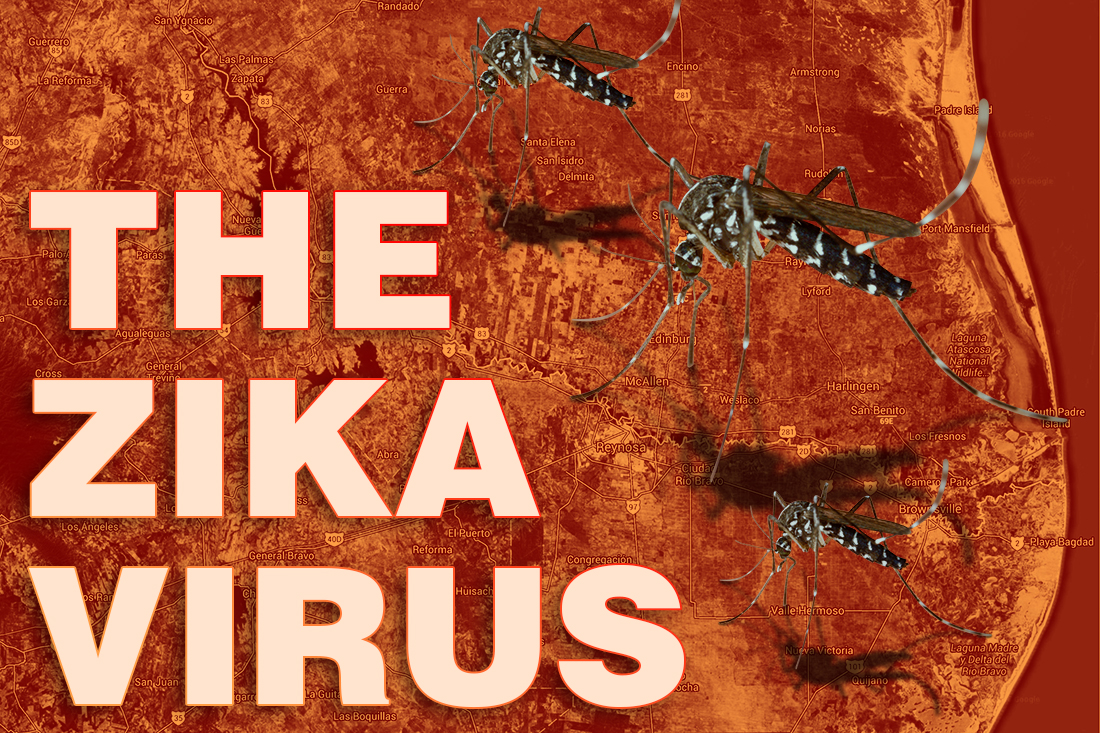
The Zika virus is not new, nor is it a life-threatening disease, but it’s catching the attention of the Western Hemisphere because it’s linked to a birth defect.
“That is not a virus that we have experienced here in North and South America and so that may be one reason why we are seeing so many people susceptible to it because there is not any natural immunity to it,” Chris Van Deusen, press officer for the Texas Department of State Health Services, said about the virus.
The Zika virus, originally from Africa, is an arbovirus that is transmitted by mosquitoes. The virus’ most common symptoms are fever, rash, joint pain and conjunctivitis (red eyes).
“But the illness itself is fairly mild. …
In fact, most people who are infected won’t have any symptoms at all,” Van Deusen said by telephone from Austin. “[It] very rarely requires hospitalization, rarely causes death, but usually passes in a week or so. In fact, we have seen the body can clear the virus, that is, eliminate the virus from the bloodstream in about seven days.”
As of last Thursday, there have been 11 reported cases of the Zika virus in Texas. Nine are travelers who were infected abroad and were diagnosed after they returned, according to the Texas Department of State Health Services website. One case involves a Dallas County resident who was infected via sexual contact with someone who acquired the Zika virus while traveling abroad.
Seven cases were reported in Harris County and two each in Bexar and Dallas counties.
Concern about the virus is due to a large increase in cases of microcephaly, a birth defect that gives newborns an abnormally small head, a condition associated with incomplete brain development, according to the Centers for Disease Control and Prevention.
“We don’t know right now exactly what’s going on, as what’s the mechanism.
Why do mothers who have been infected with Zika seem to have children with microcephaly [at] a higher rate than normal,” Van Deusen said. “It’s not all pregnant women, it’s not all children of course, but some and a higher rate.”
The virus is transmitted similarly to the Dengue virus, Van Deusen said.
He expects the virus to follow the same pattern as Dengue, which is a “large epidemic across the border in Tamaulipas … [and] some locally transmitted cases in South Texas but those are fairly limited and at a time.”
Even though it’s still winter and mosquitoes are less active at this time, the City of Brownsville’s vector control officers are already looking for mosquitoes that carry the virus.
“We trap mosquitoes, we package them up and send them to Austin for them to verify or to describe what kind of mosquitoes we trapped,” said Larry Hernandez, public health coordinator for the City of Brownsville. “The city’s part is being taken care of by going out there and fumigating and making sure we trap mosquitoes and we identify them.”
The Texas Department of State Health Services recommends people avoid mosquito bites while abroad and for seven days after returning, in case they have been exposed to Zika virus.
Joseph McCormick, regional dean of the University of Texas Health Science Center at Houston, said people should be vigilant about eliminating places where mosquitoes can breed.
“When you have standing water in any container or anything around yourhouse, then mosquitoes can breed there,” McCormick said. “Then they get inside the house. So, these mosquitoes often are found inside the house as well as around the house.”
The community can also take precautions against mosquito bites by wearing long-sleeved shirts and long pants, using insect repellents or staying and sleeping in screened-in or air conditioned rooms.
“We want to make sure that people know that they should protect themselves from mosquito bites when they are traveling abroad in those areas,” Van Deusen said. “That will help keep them from getting infected and then bringing the virus back to Texas.”
About The Author