Aarykah Navarro/ THE RIDER GRAPHIC
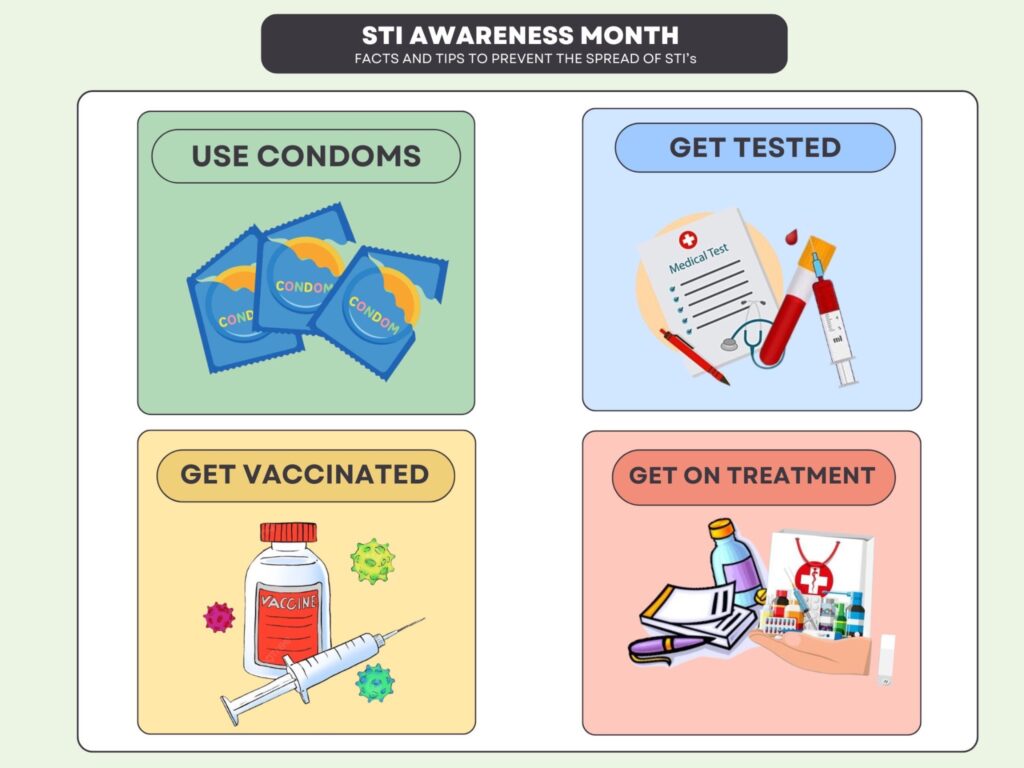
April is National Sexually Transmitted Infections (STI) Awareness Month, which provides an opportunity for the public to learn how STIs affect people’s lives and promote testing, according to the Centers for Disease Control and Prevention.
STI Awareness Week, a more focused effort, runs through Sunday. The CDC website states SAW’s purpose is to reduce “STI-related stigma, fear, and discrimination and ensure people have the tools and knowledge for prevention.”
The month provides an opportunity to address knowledge gaps and encourage open dialogue with students since it is a taboo subject, according to Vianca Vieyra, program coordinator for Talk About It campus conversations.
Vieyra added one common misconception about STIs is that symptoms are visible although most infections do not present any visible symptoms, as the most common symptom is no symptom at all.
“People won’t really know whether they have an STI or not until they get tested,” Vieyra said.
Gabriella Oliva, a social work junior, and Bryan Jimenez, a criminal justice junior, said they were not aware that April was STI Awareness Month.
“Not many people even talk about it,” Jimenez said. “I really don’t think people are educated about [STIs].”
Oliva said she was familiar with what STIs are, while Jimenez said he was unaware of STIs but knew of sexually transmitted diseases.
Both students added they do not believe students are well-educated about STIs and their effects.
Vieyra emphasized infections could be spread not only through vaginal sex, but through oral sex, blood contact such as needles and from a parent during childbirth.
According to the CDC, there were over 2.2 million reported cases of STIs in the United States in 2024.
“The three most common STIs in the [Rio Grande Valley] are chlamydia, syphilis and gonorrhea, and these are the ones that we have seen an increase in,” Vieyra said.
She said all of these infections are bacterial. Hidalgo and Cameron counties have seen a significant increase in syphilis.
As of 2022, RGV Health Connect shows that the incidence rate for syphilis in Hidalgo County is reported as 7.5 cases per 100,000 population and in Cameron County as 3.8 cases per 100,000 population.
According to the CDC, young people aged 15 to 24 are at the highest risk for contracting STIs as they account for nearly half of all new STI cases in the U.S.
“It’s college; a lot of people are into that kind of stuff, but the worst thing that you’d want to do is give someone an STI while not knowing you … are a carrier,” Jimenez said.
Jimenez and Oliva added stigma and fear are barriers for students to getting tested.
“I really think it’s just simply down to shame … or maybe it’s either their first time and they’re really not aware of the other person’s … past intimacy,” Jimenez said. “We just have to accept the fact that we’re adults now and deal with the consequences. We might as well continue being adults and have [a] civil conversation about this.”
Oliva said it is important to get tested for health and hygiene reasons to ensure that you are not passing on infections to anyone.
“If you have had sex, get tested just in case,” she said.
Jimenez added he has seen tabling events around campus, handing out contraceptive products such as Plan B and condoms to get the conversation started on safe sex and preventative measures.
“I really don’t think that is enough,” he said. “You actually have to sit down and talk to people about it.”
Oliva said she believes clinics at UTRGV could offer more resources to benefit students, so they can get tested.
Vieyra said the UTRGV Student Health Clinic offers STI testing and educational workshops for students on both campuses by appointment and walk-ins.
It is recommended to get tested at the beginning of every sexual relationship or at least every six months, according to the Talk About It program coordinator.
She added if someone does have an STI, there are things that can be done and resources available for students to feel empowered about their health.