


THE RIDER FILE PHOTO
The announcement of the expansion of Rio Grande LNG and America First Refining at the Port of Brownsville has raised questions and concerns among community members.
Reynaldo Arriaga, a cyber security senior, said he was “pretty against” the announcement of the America First Refining.
“Considering that SpaceX is already kinda messing up our habitat, there’s a lot of shrapnel going on the beaches, so I heard the oil refinery, I was, like, ‘this stuff’s gonna get a lot worse,’” Arriaga said.
Christopher Basaldú, co-founder of South Texas Environmental Justice Network, said concerns with this type of project center on fossil fuels, fracked gas liquefaction and export terminals.
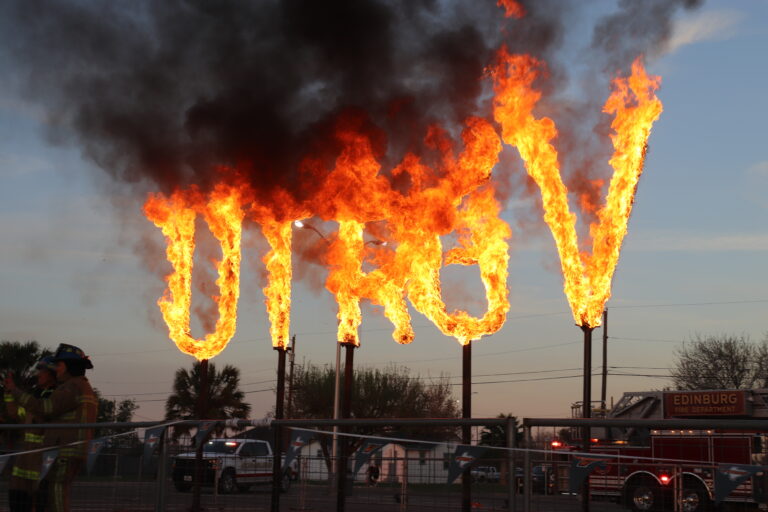
“There’s always the potential for a catastrophic explosion,” Basaldú said. “I think recently there was another explosion at the Valero oil refinery, for example.”
He added methane gas is flammable, which comes with the risk of potential explosions from pipeline breaks or leaks when facilities have safety issues.
Basaldú said it is never 100% of the gas that gets processed in these factories, and the gas lost is released into the atmosphere through venting.
“Methane is one of the most powerful greenhouse gases, which will increase the warming of the atmosphere, warming of the planet, and leading to climate catastrophe or climate chaos,” he said.
Basaldú added other gases that are produced in processing methane is Benzene, a highly toxic and cancer-causing chemical, and carbon monoxide, carbon dioxide and sulfur dioxide, that produces air pollution.
“Another big environmental risk that we need to consider is that gas liquefaction facility like Rio Grande LNG are very heavy water-intensive industries,” he said.
Basaldú said he believes there are not enough environmental regulations to manage the potential risks of this type of project.
“The regulatory bodies, at federal level, would be the Federal Energy Regulatory Commission and the Texas Commission on Environmental Quality,” he said. “For decades, both of those organizations they’ve kind of just proved to the public that they are just a rubber stamp for these very toxic industries.”
Basaldú said his organization has held information sessions to help the community stay well-informed about the risks of gas and oil projects.
From the info sessions, he said some of the concerns local residents have are that much of the material shared by these companies is not available in Spanish, and how it will affect the local environment.
“The most recent public meeting they had [was] March 24 and 25 in Port Isabel; they didn’t even have a Spanish translator,” Basaldú said. “So, that means that people showing, if people wanted to make their comments in Spanish, there was no way for those comments to be translated for the government regulators.”
In a March 25 email sent to The Rider, Jorge Montero, director of Communication for Port of Brownsville, wrote America First Refining stated the project will create 500 direct full-time jobs, with projected annual salaries ranging from $80,000 to $100,000.
“Activity at the Port of Brownsville generates more than 14,000 local direct and indirect jobs across the Rio Grande Valley, primarily from Cameron County,” Montero wrote.
He added hiring commitments are driven by private companies, but the refinery should be similar to the Rio Grande LNG project, which has created about 5,000 construction jobs to date and 73% of the jobs are local hires.
“One of the missions of the Port of Brownsville is to create good-paying jobs for our local communities,” Montero wrote.
He added the Port of Brownsville does not serve as the lead regulatory authority but works closely with tenants to ensure they understand and comply with all applicable requirements.
“Environmental stewardship remains a core commitment of the Port of Brownsville,” Montero wrote. “We expect this project to not only meet but exceed the rigorous standards required to protect our natural resources and the surrounding communities.”
He added the project has obtained America First Refinery’s necessary permits, and their expectation remains tied that they will continue to fully meet all regulatory requirements.
At the 2026 State of the City Address, Brownsville Mayor John Cowen said the new refinery, planned to break ground in April, will lead the way in sustainability, as it is designed to run on clean power to produce fuels with a lower carbon footprint.
The mayor said the refinery will create 2,000 construction jobs and, after construction, 500 jobs will remain permanently in the community, with salaries exceeding the median salary in Cameron County.
“The America First Refinery is expected to improve the U.S. trade balance by up to $300 billion in the next 20 years,” Cowen said. “Expanding domestic refining and boosting our nation’s energy security.”
For Rio Grande LNG, the mayor said the company has delivered a “real” impact with five-plant LNG trains.
“The project through Bechtel has a workforce of about 5,500 people, 70% of whom are from our community,” Cowen said. “Once complete, Rio Grande LNG will bring about 700 permanent jobs to Brownsville with an approximate salary of $100,000 for operational personnel.”
NextDecade’s Rio Grande LNG project is designed to meet or exceed all environmental and other regulatory requirements, which include strict standards governing impacts on air, land, water and wildlife, according to its website.
According to the NextDecade website, “they are committed to environmental stewardship, which includes minimizing emissions and mitigating impacts to wetlands and wildlife.”
In an April 9 email sent to The Rider, Susan Richardson, senior director of communication for NextDecade, wrote if residents want to address questions or concerns, they can email feedback@riograndelng.com or call (888) 209-6643.
—Sophia Cortez and Ethan Maldonado contributed to this story.