
UTRGV Translation and Interpreting Programs celebrated its 10th year offering a bachelor’s degree and awarded scholarships and certificates of completion to students last Wednesday during a NEXUS presentation.
NEXUS is described as the College of Liberal Arts’ Research, Teaching & Service Symposium, according to the event flyer.
The Translation Research and Action (TRA) celebration began with a showcase of research in translation studies by José Dávila-Montes, a professor of translation and interpreting.
“We tend to see translation as something that is only based in training for people to do translations, but it is also made up of research that allows us to see things that other disciplines don’t look into because they look at them very often from a monolingual stand,” Dávila-Montes told The Rider about his presentation.
Gabriel González Nuñez, director of Translation and Interpreting Programs, shared background information about how the independent program was founded at UTRGV.
The first classes for translation and interpreting in Spanish began in the late 1970s at Texas Southmost College.
In the 1990s, legacy institution University of Texas at Brownsville/Texas Southmost College began offering an associate’s degree, and in the early 2000s, the school began to offer a bachelor’s degree in Spanish with a minor in translation and interpreting.
In 2009, the school began offering a bachelor’s degree in Spanish translation and interpreting, created by Dávila-Montes.
That same year, the Texas Association of Judiciary Interpreters and Translators began funding scholarships for students in the program.
In 2010, UTB/TSC became the first university in Texas to offer a master’s degree in Spanish translation and interpretation and the first in the country to be 100 percent online, according to González Nuñez.
UTRGV’s Translation and Interpreting Programs now offer
the following:
–bachelor’s degree;
–minor in Spanish translation;
–certificate in healthcare interpreting;
–Master of Arts in Spanish translation and interpreting;
–graduate certificate in court interpreting;
–graduate certificate in healthcare interpreting;
–graduate certificate in literary translation;
–graduate certificate in localization and audiovisual translation;
–and a graduate certificate in Spanish translation.

“I want people to understand that it’s a blessing to grow up being bilingual, and that’s a starting point with which, if you train yourself, or if you let us train you, you can then do a lot of good in the world and make a living,” González Nuñez told The Rider.
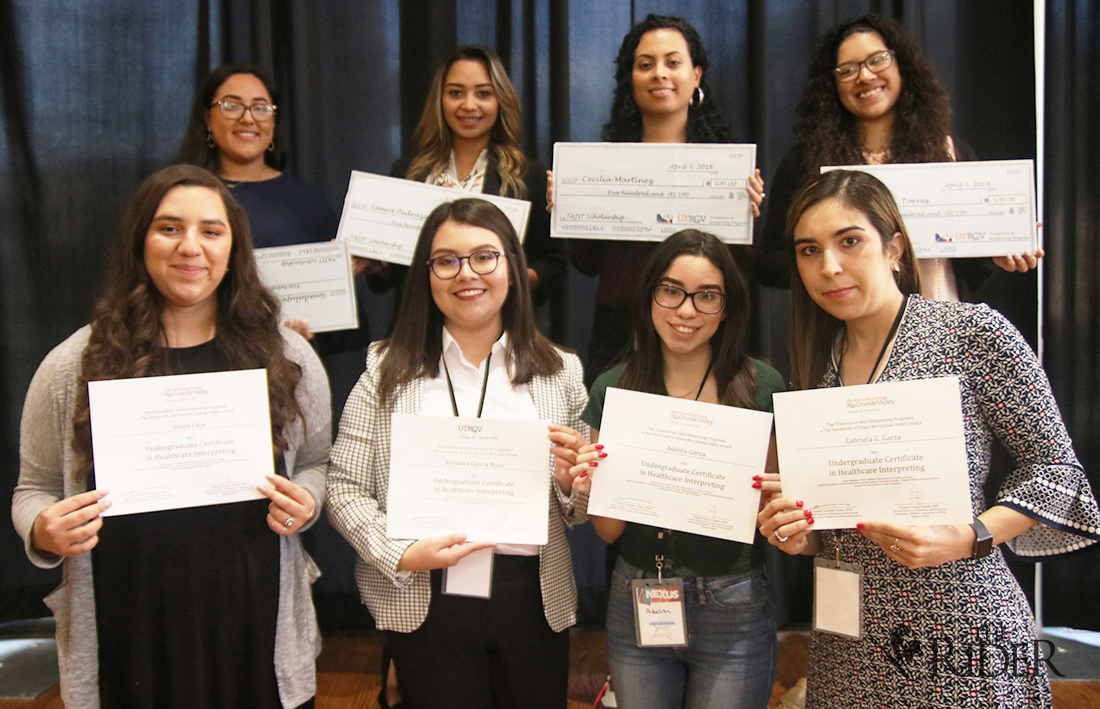
At the end of the event, the independent program awarded four undergraduate certificates in healthcare interpreting to program seniors Verónica García, Adelita Garza and Gabriela Garza. Diana Lara, who graduated from the program in December, also received the undergraduate certificate. Lara served as one of the event’s interpreters and is pursuing a master’s in the program.
TAJIT scholarships in the amount of $500 were awarded to students in the bachelor’s program: junior Guadalupe Ortiz and seniors Laura Pedraza, Cecilia Martínez and Sandra Torres.
Asked about the program, Ortiz replied, “I definitely love the classes. I love the professors. It’s a really engaging environment in the classes.”
Nazaret Fresno Cañada, an assistant professor of translation and interpreting, held a roundtable featuring García; Daniel Muñoz, senior of the bachelor’s program; Nelson Troncoso, alumnus of the bachelor’s program and a Texas licensed court interpreter; and Priscilla Pastor, alumna of the online master’s program and a Texas licensed court interpreter.
“It’s not enough to be bilingual, especially if you want to be a professional interpreter,” Pastor said in an interview with The Rider. “Without this program, I don’t think I would have been able to do the work that I do right now.”
About The Author