With the increase in Immigration and Customs Enforcement in Brownsville, some officials and residents have shown concerns for both safety and the future of the city.
On Jan. 29, Brownsville Mayor John Cowen spoke as a moderator during the U.S. Conference of Mayors 94th Winter Meeting in Washington D.C.
Cowen talked during the session titled “How Cities Are Responding in the Current Immigration Climate” and said the city assists the federal government.
“But at the local level, our [police department has] a separate but equally important responsibility,” he said. “We have a responsibility to ensure public safety and maintain the trust of our community.”
Cowen said the department does not work with ICE to make immigration-related arrests on a day-to-day basis.
“However, as we would work with any federal, state or local agency, the Brownsville PD does and will respond to requests for aid or assistance when public safety is involved,” he said.
Linda Macias, District 2 city commissioner, wrote in a Jan. 17 Facebook post ICE authorities would become more active in the city.
The Rider reached out to Macias for an interview regarding the agency’s local activity in an email Jan. 28. On Jan. 30, she said she would not give out any interviews or comments and had declined 10 previous interview requests.
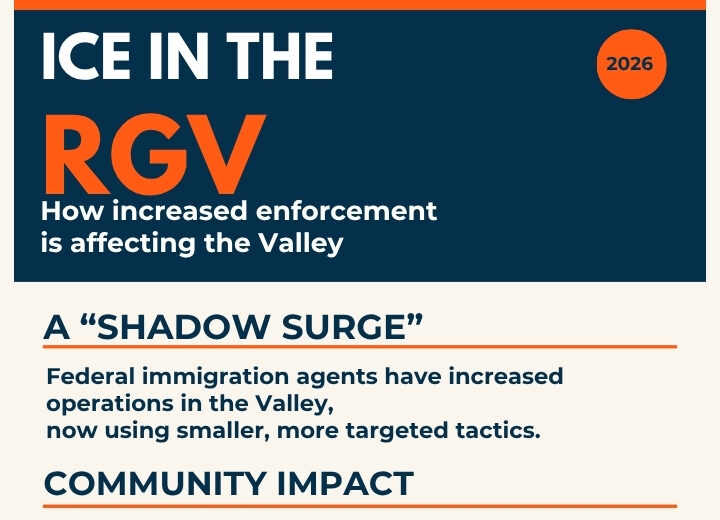
Cowen, during the session, said ICE operations have increased over the past month, mainly “targeting construction sites, hotels, restaurants and low-income neighborhoods.”
The “ripple effect” in the economy has affected city finances and services, creating fear in the community.
“There are many children that are not going to school due to fear that their loved ones may be targeted,” the mayor said. “These enforcement operations have had a chilling impact through our regional communities. More importantly, as mayor, I am concerned that our members may not call the police or fire departments for emergencies out of fear, which fundamentally makes our community less safe.”
Mark Kaswan, a UTRGV professor in the School of Political Science, Public Affairs, Legal and Security Studies, said Rio Grande Valley contractors gathered to make a plea to local political leadership and members of Congress.
“[The plea was] to ask ICE to back off of the enforcement on construction sites,” Kaswan said. “Which there had been several raids and this was having a very significant impact on construction in the Valley.”
Kaswan said the effect can already be seen in the city as fear may prevent people from going out of their homes.
“They’re not shopping; they’re not eating out,” he said. “So, it can have a pretty significant economic impact on the consumer side.”

Mariajose Garza/THE RIDER
Branton Puente, a cyber security sophomore, said his family feels the concern and worry.
“One of my tios had a whole two-week period of … staying in his house and not going to work because there was major ICE activity at Los Fresnos,” Puente said.
Yesenia Reyes, a marketing freshman, said she does not support the agency.
“I don’t think it’s the way to go or the way to do something,” Reyes said. “Obviously, it’s extremely wrong because of the events that have been happening with the few people that just passed away because of the ICE raids.”
Christina, an accounting senior, who declined to give her last name, said she has not noticed any ICE activity.
“I’ve mostly just heard about it on social media, but I haven’t seen anything on my side,” Christina said. “… I think just the media is kind of taking it out of context.”
She added she supports the agency and its efforts to remove individuals living in the country illegally.
“They’re just doing their jobs,” Christina said. “They’re just doing what they’re being told to do.”
Kaswan said ICE’s main authority is law enforcement, focusing now more on the immigration part of its responsibilities.
“They’re also responsible for customs,” he said. “Customs means goods that are imported into the country. They’re the folks who collect the tariffs that have been imposed.”
Kaswan added the agency has the authority to arrest and detain people who are believed to lack permanent legal status and initiate deportation proceedings.
He added, however, since the crime is a misdemeanor, individuals who are detained are not supposed to be jailed.
“Their detention is not supposed to be a punishment,” the professor said. “It’s intended to be kind of a holding place until their immigration status is resolved.”
Kaswan said people who come into the United States have the right to apply for asylum, giving individuals legal status that needs to be adjudicated. In some instances, adjudication could take up to two to three years.
He added many people being detained have asylum claims and are legal residents.
“They’re picking up citizens,” Kaswan said. “They’re picking up tribal citizens, people from indigenous tribes who happen to be brown. So, they’re pretty significant numbers of people who do not fit under the classification of an illegal resident. Let alone the [Donald] Trump administration’s [claiming] they’re only going after dangerous criminals.”
The professor said there are several proposals in Congress working to limit the agency’s authority.
“For example, respect for civil liberties, making sure that ICE agents don’t have an immunity if they break the law when they are in the process of enforcing the law,” Kaswan said.
Cowen said Brownsville is a place for international trade, aerospace, manufacturing, higher education and innovation.
“And our future depends on stability, collaboration and trust of our government institutions,” he said.
The mayor added as policies change, the city will continue its responsibility to keep residents safe and progress its economy.
“We encourage individuals to follow the law, find the resources they need to be able to go through proper legal process to obtain legal citizenship in the U.S.,” he said. “And we encourage Congress and this administration to pass comprehensive immigration reform and expand pathways and work authorizations for those that contribute positively to our communities and our country.”
To find someone who was detained, call the ICE Harlingen Field Office at (956) 389-7884 or visit ICE Online Detainee Locator System.

Mariajose Garza/THE RIDER