

Aarykah Navarro/THE RIDER
What if a past event was so traumatic that its memory haunts the present? One of the oldest standing buildings in Edinburg may be experiencing that phenomenon. It has a grim history some believe has never left its walls.
In an interview with The Rider, Jenarae Bautista, curator of exhibits and collections at the Museum of South Texas History, shared its inception as a former Hidalgo County Jail to its renovation as a museum and the haunted folklore it inherited.
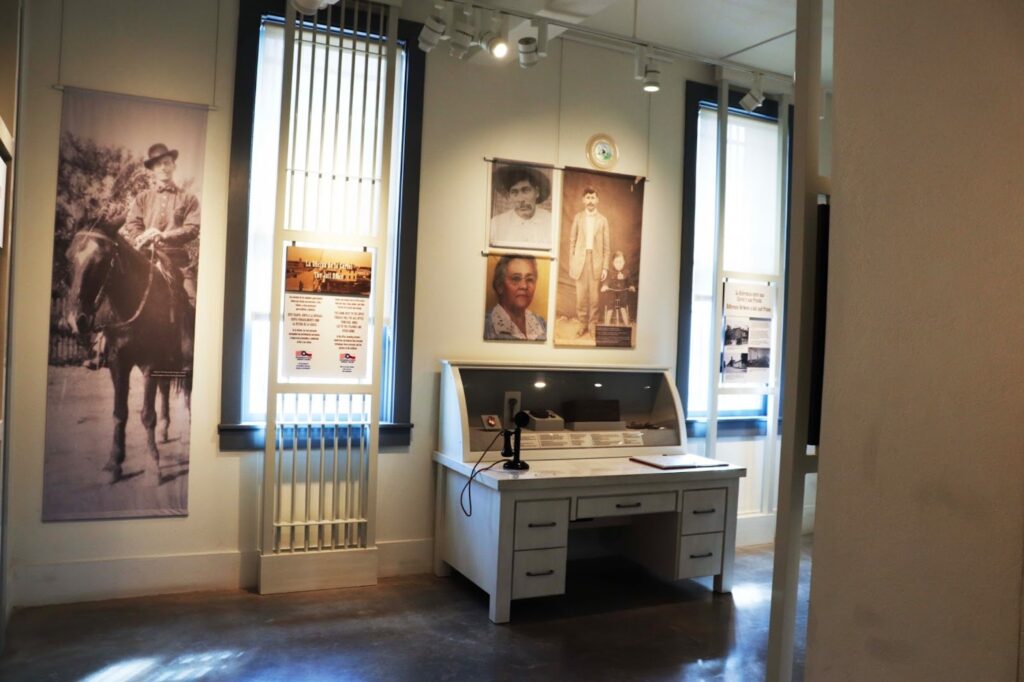
The 1909-1910 structure was initially built alongside the county courthouse and served multiple roles, including jail, city hall and a police station, before becoming a museum in 1970, according to Bautista.
Today, its stark past fuels the popular local folklore that the building is haunted, with museum staff and visitors reporting experiences with its spectral residents, according to the curator.
Perhaps the most chilling artifact in the museum is the replica gallows and noose, a visual reminder of the one confirmed execution that took place in 1913.
The man hanged was Abraham Ortiz, found guilty of murder and assault.
Bautista recounted the tragic nature of the event, including Ortiz’s final, poignant words in Spanish: “There is no heaven and there is no hell.”
She said the execution was meant to be a terrifying public spectacle.
“We have written accounts of locals who just said, like, you could hear it,” Bautista said. “You could hear the thud. You could hear the clang.”
The curator added some townspeople, unwilling to be a part of it, took their children and left the city before the execution occurred.
Visitors can still hear a sound effect of the trap door opening when they visit the execution area, according to the curator.
The solitary cell, where Ortiz was held before his execution, is also available for the public to visit and to experience the space with the large original metal door barricading them in.
Another death occurred in the solitary cell when brothers Jose and Bartolo Lopez were set to be executed in 1910, but Bartolo committed suicide inside the day before the execution.
Bautista added those who enter the solitary cell sometimes “feel a little bit of a presence” or “something on your chest,” suggesting he may also be present.
She said the most frequently reported spirit is of Nemesio Cortina, the first jailer, who lived on the first floor of the jail with his wife, Marcella.
Though he did not die within the jail walls, he died in 1916 as a result of injuries sustained after a fall down the jail’s stairs.
“I’m now convinced that his spirit kind of hangs out and says, ‘Hello’ once in a while, if you will,” Bautista said.
She said she heard a disembodied male voice call out, “Staying late?” A personal experience of working after hours, which she described as the presence of an “older man … kind of like a señor.”
Bautista added the experience “never feels malicious.”
Although not everyone believes, reports of strange occurrences are not uncommon, she said.
The curator said staff members who have offices in the building report hearing paper rustling and phantom knocking on their doors.
Police officers who patrol the area at night have reported seeing a “glimmer” or “light” near the second-floor hanging room area, according to Bautista.
She said she rationalizes the paranormal with a spiritual approach, saying she enters the building with a friendly “Hello” and tells the spirits she is there to tell their story.
“I’m not terrified,” Bautista said. “I’m not afraid to go into the building. I’m not afraid to do my job there because it’s just about respect.”
To visit the 1910 Old Jail or learn more about the museum, visit MOSThistory.org.
About The Author