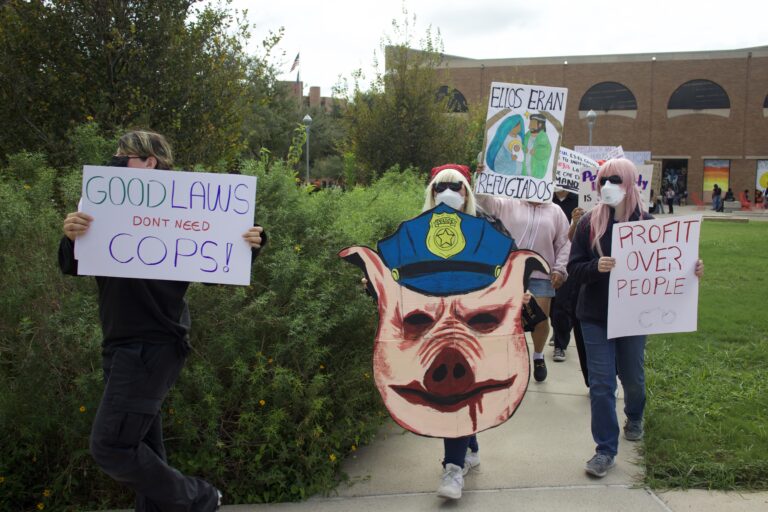

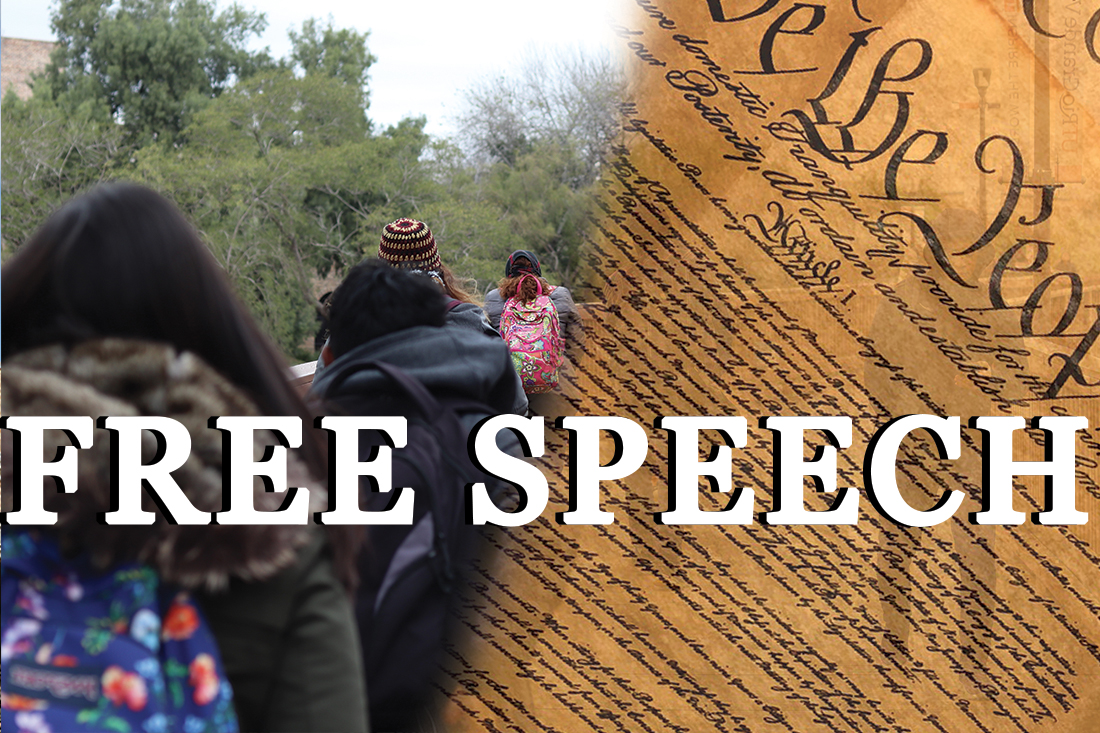
To avoid losing federal research funding, universities will have to comply with President Trump’s new executive order, which asks for universities to promote free speech on campuses.
“Taxpayer dollars should not subsidize anti-First Amendment institutions,” Trump said during a ceremony before signing the executive order March 21 at the White House. “And that’s exactly what they are–anti-First Amendment. Universities that want taxpayer dollars should promote free speech, not silence free speech.”
Trump signed the executive order titled, “Improving Free Inquiry, Transparency, and Accountability at Colleges and Universities,” which aims “to enhance the quality of postsecondary education by making it more affordable, more transparent, and more accountable,” according to the order.
However, there has been confusion about what this executive order means, since universities already have to adhere to the First Amendment, which guarantees freedom of religion, expression, assembly and the right to petition.
“It shouldn’t really have an effect, legally speaking, because the First Amendment already covers this question,” said Charles Olney, a UTRGV political science assistant professor. “Public universities are not allowed to discriminate on the basis of content of speech.”
Olney said universities could experience the “chilling effect” as a result of Trump’s executive order.
“There is a phrase called the ‘chilling effect’ in free speech literature where it’s not that you explicitly regulate speech, but you create an environment where people are worried and they say, ‘I don’t want to get prosecuted. I don’t want to put ourselves in danger. Let’s just not even get close to the edge,’” he said. “So, if there is an effect, it’s likely to be that.”
In an interview with The Rider, Patrick Gonzales, UTRGV’s associate vice president for University Marketing and Communications, said he does not see the executive order affecting the university.
“With that said, I know that part of the executive order is that the president gave these federal departments the right to implement policies and procedures based on freedom of speech,” Gonzales said. “As far as I know, those haven’t been announced by the individual departments. So, you know, obviously, we’ll have to wait to see what they develop based on this executive order and we’ll have to comply with those as necessary.”
The order will not create a stricter standard of freedom of speech on college campuses but “symbolically, it says, ‘We are keeping an eye on this. We are watching you,’” Olney said.
Asked if the federal government is capable of taking funding away from universities that fail in complying with Trump’s executive order, he replied, “You can’t just arbitrarily take funding away that has already been allocated or determined, but a lot of federal funding for research projects are administered through the federal branch. … I think that if nothing in particular changes, in terms of what campuses are actually doing, and then the president says, ‘Because of this executive order, I’m now taking away $75 million worth of funding from you,’ there probably would be a lawsuit.’”
Gonzales said UTRGV will continue to adhere to the First Amendment.
“Our position is to continue doing what we currently do when it comes to freedom of speech on the university,” he said. “As a state public university, we must adhere to the First Amendment and those legalities that come with it, and that’s what we’ve been doing and that’s we’ll do.”
Regarding the enforcement of the order, Olney said it is not specified.
“It’s very hard to tell because free speech is a very amorphous question,” he said. “What do you need to do in order to show that you have met certain standards about free speech? That’s not been articulated.”
There is a lot of research on this topic that proves free speech is not a problem in university campuses, Olney said.
“The research that’s been done on this question has been pretty conclusive to say that there is no free speech crisis in particular,” he said. “Obviously, we can always do better … but it’s not clear that there’s a problem that needs to be solved.”
Para la versión en español de este artículo, oprima aquí.
About The Author