Jose Rodriguez/THE RIDER
On Jan. 12 in a quiet corner of Kreative Grounds Café in McAllen, the air was suddenly thick with the crushing weight of static feedback and rhythmic distortion. This was not a traditional music lesson; it was a crash course in power electronics.
Led by musician and sound artist Eric Linares, who performs under the moniker Crust Fund, the three-part workshop, Freedom through the noise: A power electronics and ambient workshop, aimed to demystify “power electronics,” a visceral branch of sound art that defies conventional melody in favor of raw sonic texture.
Drawing on over 20 years in the experimental scene, Linares said his knowledge of harsh noise is a product of persistent trial and error.
He views noise art as “anti-music” because it purposely rejects the traditional structures and constraints of music.
“It’s very freeing in that aspect,” Linares said.
He shared a history of experimental music and its evolution into sound art, citing examples such as Merzbow, Pharmakon and Never Sorry that have shaped the genre.
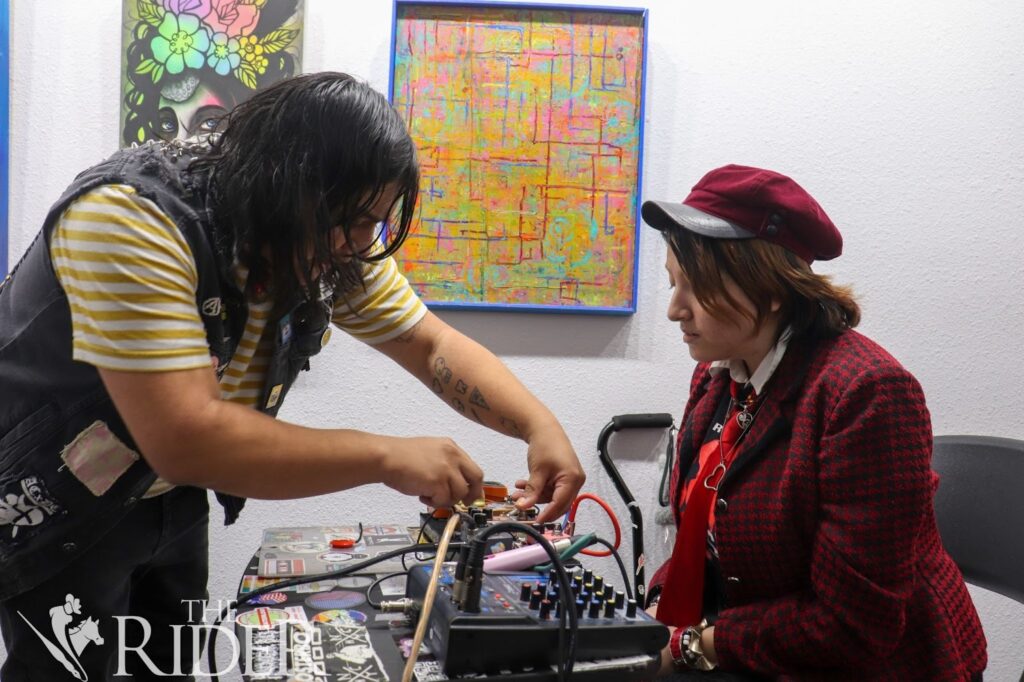
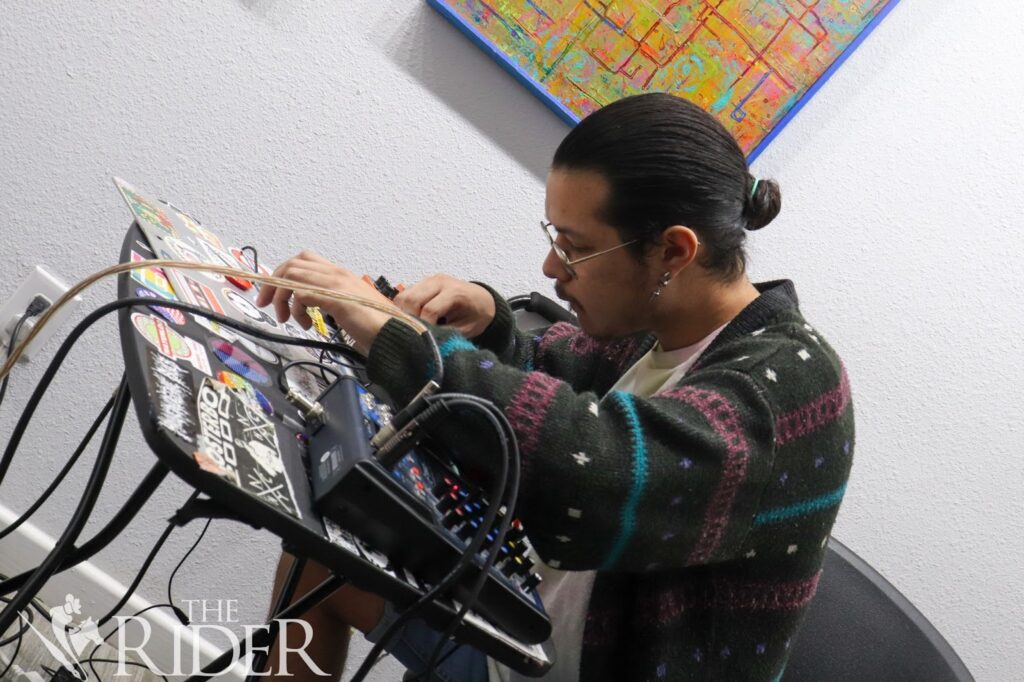
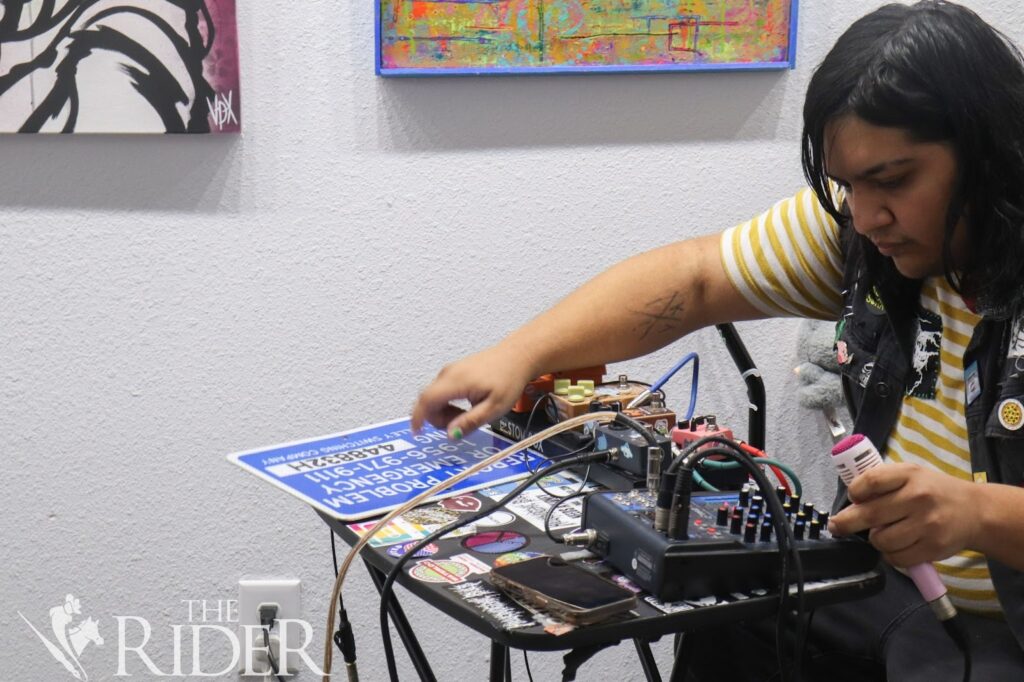
Linares demonstrated his setup, including an audio mixer, fuzz pedal, delay and contact microphones.
He encouraged participants to experiment with simple equipment, including a street sign rigged with a contact microphone, that could transform everyday objects into instruments of protest.
Jose Rodriguez/THE RIDER
“It’s a blank canvas,” Linares said. “You can take it and make what you want with it, and it’s endless.”
The sound artist described creating noise art as a potentially healing medium.
“It can be very therapeutic if you want it to,” he said.
For Linares, the therapeutic nature comes from the escapism of getting lost in specific tones that “feel nice to listen to.” By moving away from rigid structures, he said, artists are free to use raw sound to “get out emotions.”
In an interview Wednesday, The Rider spoke to Dr. Ney Alliey Rodriguez, a classical guitarist and assistant professor in the School of Medicine, to understand the effects of sound on brain chemistry.
Like Linares, Rodriguez hesitated to define noise art as music, noting a distinct absence of traditional harmony.
Yet, he said chaotic sounds may contain rhythms that elicit profound physiological responses.
“Actually, I got a little bit startled with some of these sounds,” Rodriguez said.
From a neurological perspective, the barrage of sounds in noise art functions differently than melodic patterns, the doctor said. While harmonious music often aligns with the body’s natural rhythms, such as respiration, noise art often triggers the central nervous system’s survival response.
“What you release at that moment is adrenaline, OK, norepinephrine and epinephrine,” Rodriguez said.
Jose Rodriguez/THE RIDER
He suggested this is due to “subtle responses” embedded in the sound. When people listen to rhythms, they often “try to elicit, to imitate that rhythm without being conscious of that.”
The physical “adaptation” allows the body to synchronize with the sound. This startle-and-release cycle could even have clinical applications in treating Post-Traumatic Stress Disorder through “fear extinction,” the doctor added.
“If you repeat and repeat, repeat, you lose the startle response,” Rodriguez said. “… This is how we learn and we unlearn fear.”
While he maintains a preference for “natural scales,” he acknowledged the perception of noise is highly subjective.
“There are people who can really respond better to harsh environments, and that may be a natural adaptation,” Rodriguez said.
As the workshop shifted into “free play,” the café hummed with new artists finding their voice.
For Aaron Robledo, a musician from Edinburg, the workshop provided a rare space for rebellion. Robledo said he views the act of creation as a biological transfer of energy.
“When we create, that electric signal passes through our fingers, and it passes into the instruments that we touch,” he said. “That’s why everyone that went was completely different because everyone’s individual current is different. I think that’s, like, really beautiful.”
Linares concluded the workshop with a call for local artists to move experiments into the public eye.
“We need some art back in the music,” he said. “Share your art. Share your art everywhere. It’s bad? Who cares?”
For more information on the next workshops, visit Linares’ handle on Instagram @xcrust_fundx.

Jose Rodriguez/THE RIDER