Photo Courtesy @Office of the Governor Greg Abbott/Facebook
As of press time Friday, no decision had been made on the U.S. motion for a preliminary injunction that would require Texas to remove the buoys barrier from the Rio Grande within 10 days if granted.
The motion was filed July 24 in the United States of America v. Greg Abbott et al lawsuit in the U.S. District Court for the Western District of Texas. Both sides in the case filed their closing arguments Aug. 25.
In its closing argument, the U.S. argued that the barrier, which is located at Eagle Pass, is causing harm to relations with Mexico and making the Rio Grande unnavigable.
The U.S. states that 10 days is more than enough time for Texas to remove the barrier.
“Texas’s recent efforts to move the Barrier in response to the [International Boundary and Water Commission’s] joint survey results demonstrate it has the personnel and equipment standing ready to begin work in a few days,” according to the preliminary injunction motion.
The International Boundary and Water Commission determined through a survey on Aug. 14 that 79% of the buoy barrier lies on the Mexican side of the Rio Grande.
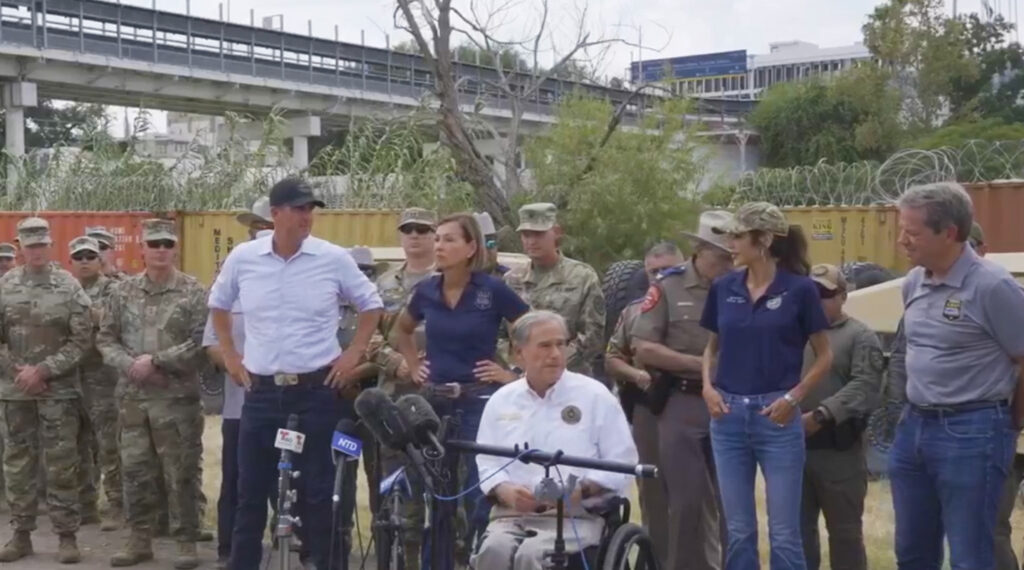
In an Aug. 21 news conference in Eagle Pass, Abbott said the floating wall had moved.
“The buoys had drifted toward the Mexico side,” he said. “And so, out of an abundance of caution, Texas went back and moved the buoys to a location where it is clear they are on the U.S. side, not on the Mexican side.”
In its closing argument, Texas disputes that no evidence shows the buoys “obstruct” any navigable capacity of the river, nor does the Rivers and Harbors Act ban the structure.
“No evidence shows the buoys are ‘booms’ or ‘other structures’ covered by Section 10 of the Rivers and Harbors Act,” the defendant’s closing argument states. “And even if there were such evidence, Texas has clear constitutional authority to defend its territory against the invasion that Governor Abbott has declared.”
The hearing for the preliminary injunction began Aug. 22. No cameras were allowed inside the federal court in Austin, where senior U.S. Judge David Alan Ezra is presiding over the case.
For more than a month, Abbott has tried to defend his new invention for border security from the U.S.-filed complaint for placing a 1,000-foot stretch floating buoy barrier in the Rio Grande.
During the news conference, the governor said the border buoys were installed in July in Eagle Pass as part of his border security initiative.
“Just last year alone, there was an all-time record number of people who died crossing the border,” Abbott said during the conference. “Eight-hundred-fifty-three people died last year. One was an 8-year-old child who died in the federal detention. Another was a 5-year-old, who died drowning coming across the river.”
Since its start, Operation Lone Star has resulted in over 420,800 migrant apprehensions, over 33,600 criminal arrests and more than 30,500 felony charges, according to an Aug. 10 news release from the governor’s office.
During this border mission, the Texas Department of Public Safety seized over 426 million lethal doses of fentanyl.
Abbott said during the conference that an infant drowned crossing the border in Eagle Pass, but it was before the buoys were installed.
Iowa Gov. Kim Reynolds, Nebraska Gov. Jim Pillen, Oklahoma Gov. Kevin Stitt and South Dakota Gov. Kristi Noem joined Abbott at the news conference to provide an update on their joint efforts under Texas’ Operation Lone Star.
“Texas has been ground zero for over two years because … the Biden [administration] created [the] catastrophe that we see at the southern border,” Reynolds said in the news conference. “Whether it’s a lack of security or public safety, it’s just an assault on our democracy.”
Arkansas, Florida, Iowa, Idaho, Nebraska, North Dakota, Ohio, Oklahoma, South Carolina, South Dakota, Tennessee, Virginia, West Virginia and Wyoming have stepped up to aid Abbott’s initiatives and sent personnel and resources to secure the border, the governor’s office stated on Aug. 21.
In an Aug. 22 phone interview, Álvaro J. Corral, an assistant professor in the UTRGV Department of Political Science, told The Rider his biggest concerns regarding border security are the buoys deployed by Abbott.
“I think recently, what’s been making the headlines has been Gov. Abbott’s use of these buoys that are in Eagle Pass,” Corral said. “They’re kind of these floating barriers that are wrapped in concertina wire, and the wire that goes underneath the water, some of it is not visible.”
He said the buoys are spurring international concern.“People are concerned because … unfortunately, lots of migrants die in their attempts to cross to the U.S. and that’s been true for decades now, whether it’s Mexico or other international organizations concerned about migrant human rights,” Corral said. “And so, this is a kind of different course of action that we haven’t really seen before.”
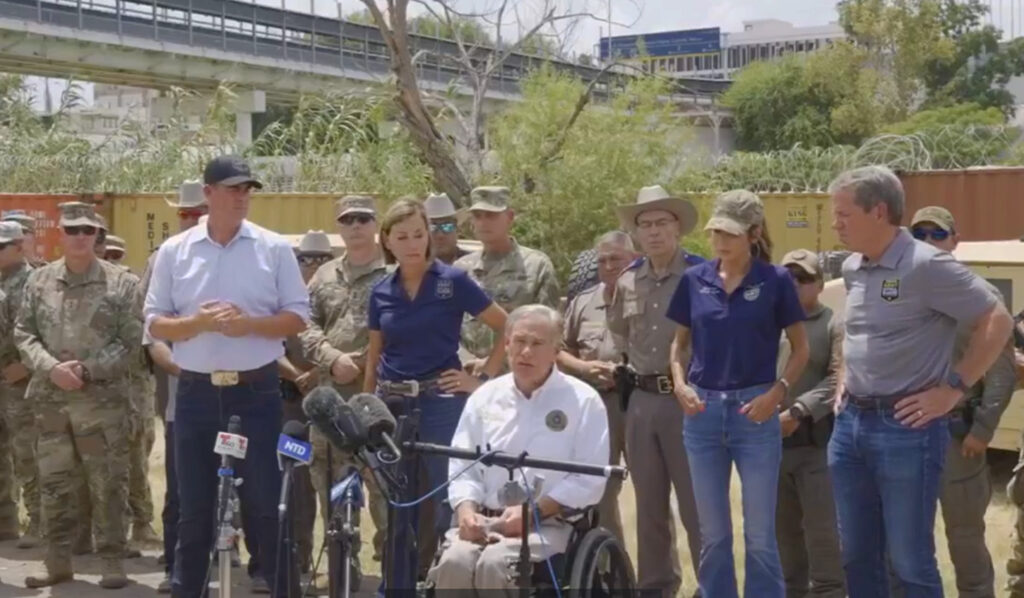
Photo Courtesy @Office of the Governor Greg Abbott/Facebook