A federal appeals court denied a request to rehear the case of the Texas 2001 law that allowed certain undocumented students to pay in-state tuition, making higher education more expensive for some.
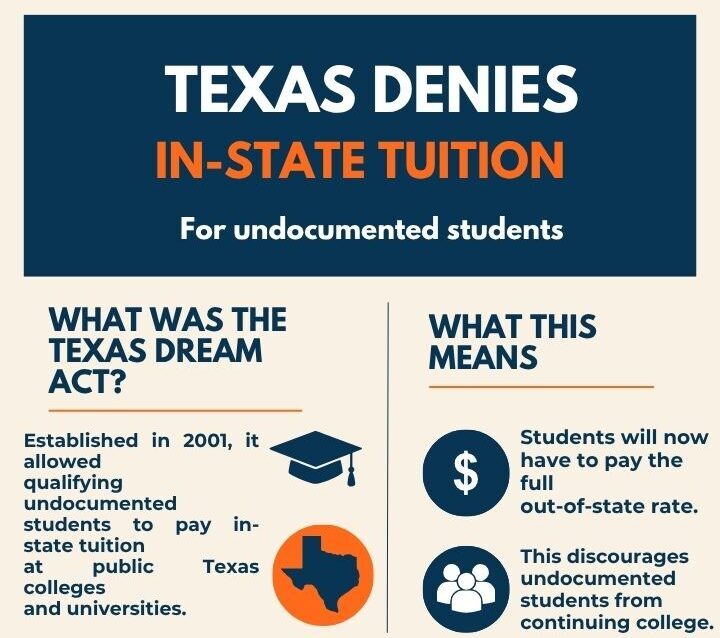
On Sept. 8, the United States Court of Appeals for the Fifth Circuit denied the rehearing request for the Texas Dream Act case after the initial invalidation of the law on June 4, 2025.
The decision affects undocumented students who pay in-state tuition at public Texas colleges and universities.
Mark Kaswan, a professor for the School of Political Science, Public Affairs, Legal and Security Studies, said Texas was the first state to adopt such a policy.
Kaswan said the loss of in-state tuition for undocumented students could have an immediate financial impact on students who want to continue their education.
“If they intend to continue their education journey, they will have to pay for it at the full out-of-state rate,” he said.
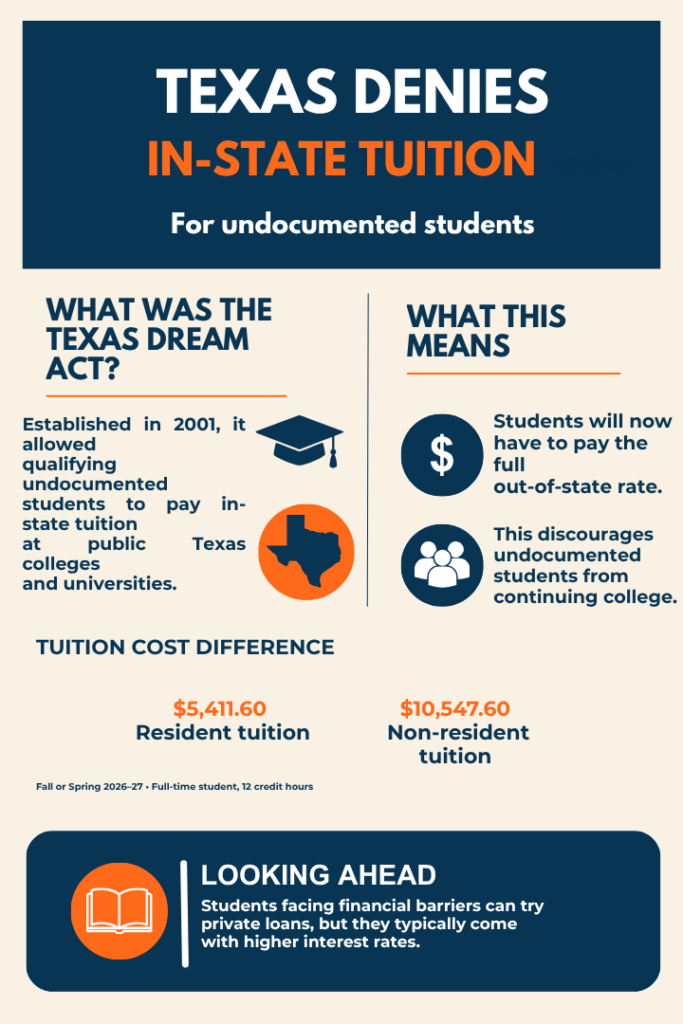
As of the 2026-27 academic year, UTRGV’s nonresident tuition is $10,547.60 for the fall or spring semesters compared to $5,411.60 for resident students, including additional fees, according to the university’s website.
Kaswan added undocumented students also face restrictions on federal and state financial aid, making it difficult to deal with increased tuition.
“It’ll eliminate, or nearly so, eliminate enrollment from undocumented students,” Kaswan said.
The issue could affect students who are undocumented as it may also put a target on them from Immigration and Customs Enforcement if they are providing their information to a state agency when trying to continue their education, according to Kaswan.
Mariel Rodriguez, a criminal justice sophomore, said the news was shocking and the student’s legal status should not prevent them from pursuing their education.
“I think legal status shouldn’t have to somehow get involved in our pursuit for a better education,” she said.
Rodriguez added she has friends under Deferred Action for Childhood Arrivals and these changes may discourage them from pursuing college at UTRGV.
“Many of our students, many of our community members … are children of immigrants,” Rodriguez said.
She said the students haven’t done anything wrong and are just here to learn like everyone else.
Rodriguez said she hopes universities and lawmakers will continue to make higher education more accessible for students.
Katie Garcia, a biology freshman, said it is already difficult for students who are citizens to pay tuition, so it would be harder for undocumented students to pay tuition because of the limited availability of financial aid.
She said, “[Lawmakers] should consider who it will affect,” when passing or denying laws.
Kaswan said arguments surrounding the Texas Dream Act have historically centered on whether the state should provide benefits for undocumented students.
Supporters argue access to education gives students greater opportunities for financial independence and job opportunity, while opponents argue state resources should only benefit U.S. citizens.
Kaswan said many of the students under the policy were brought to the United States as children and had little control over their immigration status.
For students facing financial barriers, Kaswan said they can try applying for a private loan, although private loans have higher interest rates, according to Kaswan.