

Adrian Hernandez/THE RIDER
UTRGV’s core curriculum is potentially shrinking from 42 to 30 credit hours as the university works to comply with a new state law, prompting concerns about faculty input and potential sustainability of academic programs.
On Sept. 1, 2025, Senate Bill 37 went into effect and abolished faculty senates, which held decision-making power over academics and curriculum, limiting faculty groups to advisory-only roles with no final authority over decisions.
According to the UTRGV website, the UT System Board of Regents may reestablish faculty senates consistent with Senate Bill 37’s parameters.
Can Saygin, UTRGV interim provost and executive vice president for Academic Affairs, said the bill shifts final decision-making over academic policy onto university leadership rather than faculty.
“The way I interpret [SB] 37 is that the state, the federal government … [wants] the executive leadership to make decisions as opposed to putting more on the faculty,” Saygin said.
Under administrative guidelines obtained by The Rider, state law mandates core courses to better prepare students for the workforce and professional life, while the UT System Board of Regents holds final authority over the curriculum.
The document also states the Texas Higher Education Coordinating Board (THECB) is expected to release new guidelines by December, which may reduce the number of courses in the core curriculum.
In a separate institutional framework document, Saygin outlined the university’s plans to minimize the curriculum, seemingly in compliance with these anticipated changes.
The document states the initiative treats the core curriculum as a program in its own right, redesigning it from the current 42 semester credit hours to 30, adding the updated curriculum will also feature AI-teaching material.
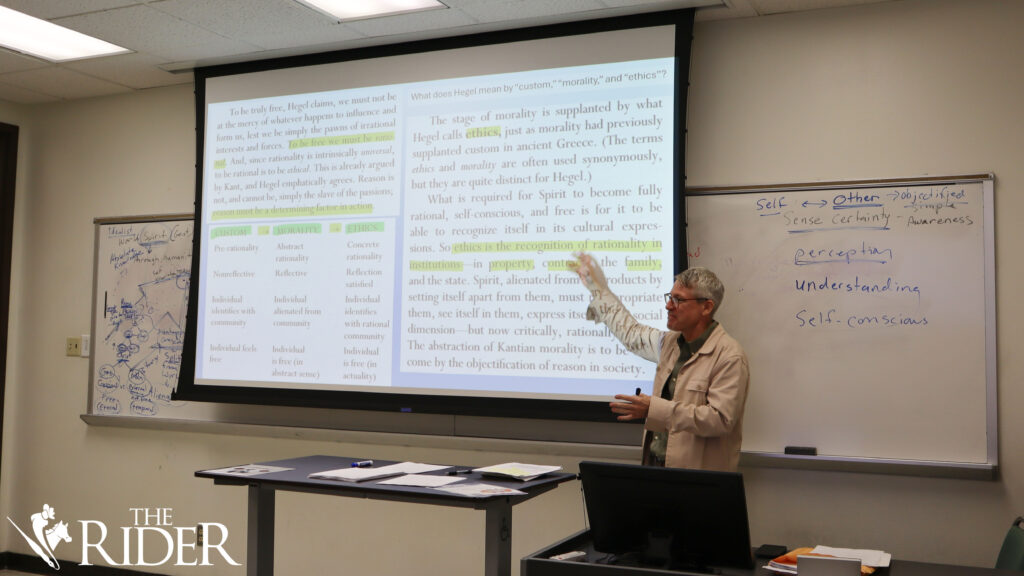
Saygin said any courses removed from the core curriculum may still be available as part of the major courses requirements, making the core more general and transferable.
“We did not eliminate any courses,” he said. “We just said, ‘These courses don’t belong in the course because they’re either major-specific, or they are too specific in [another] sense.’”
Saygin said this change can help students be more career-ready, find a job as soon as they graduate and minimize the number of narrow courses. The goal is to aim for a core curriculum applicable to all majors, with changes to the currently in process and expected to be issued around January 2027.
Regarding faculty’s role, Saygin said the university has already implemented faculty advisory bodies and is maintaining college committees to help rethink the core curriculum.
Isaiah Martinez/THE RIDER
However, some faculty members said the university has been struggling to collaborate with them.
Kristine Wirts, UTRGV professor of history and treasurer of the local American Association of University Professors (AAUP) chapter, said faculty involvement has been further paused and the administration “pretty much dictates who gets to serve on the committees.”
“Faculty has been completely [powerless] because our role is pretty much a token,” Wirts said. “We can’t really make any meaningful contributions and given the chilling climate at this time with SB 37, even faculty who have tenure are afraid to speak out.”
She added it’s a situation where the administration has overriding power.
“Making all kinds of decisions that would have traditionally been the faculty’s role,” Wirts said.
When asked what his response was to concerns about faculty not making meaningful contributions and afraid to speak out, Saygin replied he takes the concerns seriously.
“Faculty should feel comfortable sharing their perspectives, confident that their contributions matter, and informed about the decisions that affect their programs,” Saygin said in an email statement. “Concerns about how changes to the core curriculum may affect program sustainability and the breath of academic offerings deserve careful consideration.
“This is my first semester as Interim Provost, and I began sharing my vision and operational plan in August 2026. That vision centers on three pillars: Student Success, Faculty Success, and Program Success. The initiatives outlined in the documents below are intended to create meaningful opportunities for faculty, students, and staff to help shape improvements and advance UTRGV’s institutional impact.
“Building trust, strengthening communication, and turning engagement into tangible results will take time and sustained effort. My commitment is to make steady progress through open dialogue, clear communication, and meaningful opportunities for faculty input.”

Adrian Hernandez/THE RIDER
For curriculum in particular, Wirts said faculty would at least have a role and were provided with greater transparency during the process, noting this is not the case anymore.
She said while she understands the importance of the careers readiness for the university, there has currently been an imbalance where career readiness completely overshadows academic quality.
Regarding specific curriculum changes Saygin noted, Wirts said while courses removed from the curriculum are still available, not having them as required under the core curriculum loses guaranteed enrollment and funding for whichever department loses that course.
She said humanities and creative sections in particular may be at risk of losing guaranteed enrollment provided by the core curriculum, noting a change like this hurts a program’s sustainability.
Psychology freshman Fatima Cuellar said this is a difficult situation as she likes the idea of having fewer required core courses but understands the risk this can pose to academic options.
Cuellar said she hopes faculty can have more say on their end and could contribute to a more balanced curriculum.
Wirts said students have more power than they realize, encouraging them to speak up for changes they want for themselves and others they care about.
About The Author