

Elon Musk
BY Nubia Reyna | THE RIDER
SpaceX CEO Elon Musk plans on colonizing Mars by 2024 and making humans a “multi-planet species.”
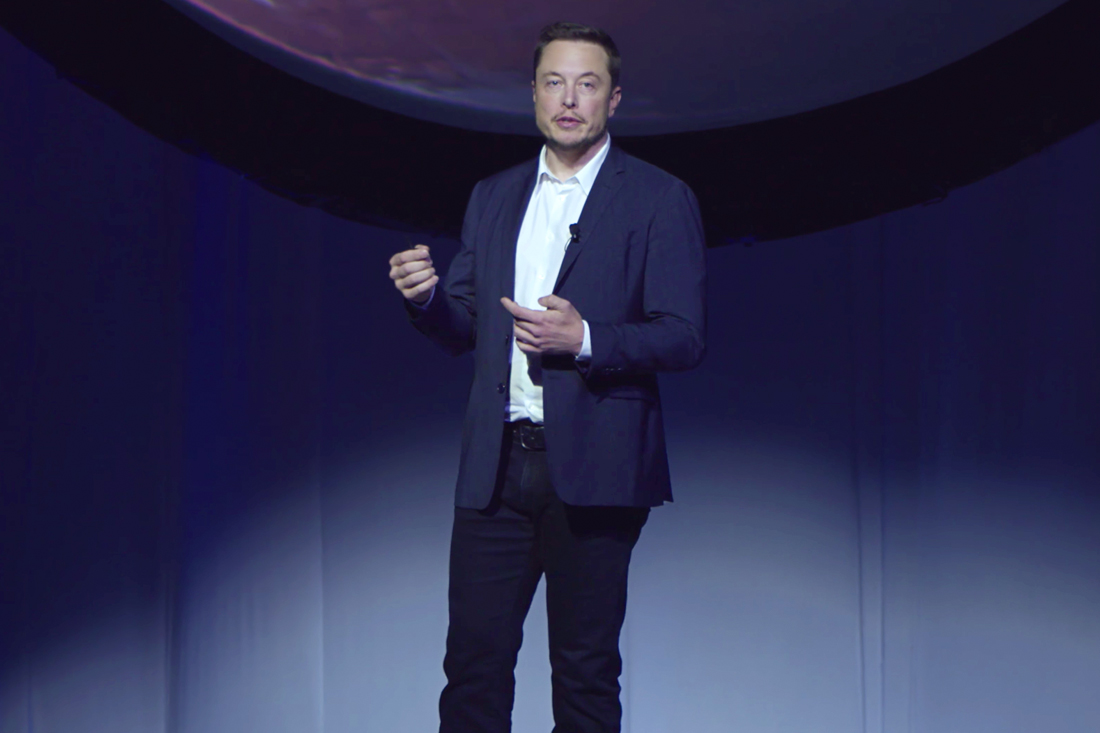
Musk spoke in front of an audience of more than 3,000 people at the International Astronautical Congress in Guadalajara, Mexico, last Tuesday. The address was live streamed.
“What I really want to try to achieve here is to make Mars seem possible, make it seem as though it’s something we can do in our lifetimes,” Musk said.
The first spaceship to Mars, which is nearly 34 million miles from Earth, has not yet been finalized. The spaceship will have a diameter of 17 meters, or 55.77 feet. The ship will have a powerful rocket booster, which will separate from the craft and land back on Earth.
“Once that transport system is built, then there’s a tremendous opportunity for anyone who wants to go to Mars and create something new or build the new foundations of a new planet,” Musk said.
The Interplanetary Transport System rocket booster would be taller, wider and three times more powerful than the Saturn V rocket, which transported astronauts to the moon. Each booster rocket would use 42 of SpaceX’s Raptor rocket engines, and the passenger spaceship will only have nine raptors.
“It’s quite big. … I think in the long term, the ships will be even bigger than this,” Musk said.
Once the booster lands, it will gear up for its next launch of a propellant tank. Then, the tank is going to dock with the spaceship in orbit filling it up with the gas needed to go to Mars. Musk said it will take three to four propellants to fill the tank with the gas needed to go to Mars.
In order to be a self-sustainable species, Musk estimates that 1 million people are needed in Mars.
“If you have 100 people per ship, that’s 10,000 trips,” he said.
It would take from 40 to 100 years to achieve a self-sustainable civilization in Mars at the rate of 20 to 50 total trips.
“The trip time at 6 kilometers per second is as low as 80 days,” he said. “Over time, they’ll improve that as low as 30 days.”
Once the spaceship arrives to Mars, it will use “supersonic retropropulsion,” which means that the ship is going to land by using its engines to lower itself to the ground. After leaving the passengers, the ship will come back to Earth.
Since the engines of the ship run on methane. The gas can be made from the carbon dioxide available in Mars.
The cost of the trip is $10 billion but Musk plans on lowering it to $200,000 a ticket, thanks to reusability and propellant, as well as having 200 people per ship instead of 100.
“The goal is to ship 100 passengers per ship, although, you’ll probably see it go to 200 or more,” Musk said. The ticket price could come down to “maybe as little as $100,000 over time, depending upon how much mass a person takes.”
Asked who would be Mars colonizers, Musk replied that it had to be people that are mentally prepared to die.
“I think the first journey to Mars is going to be very dangerous. It’d basically be, ‘Are you prepared to die?’” Musk said. If so, “OK, you’re a candidate for going. This is less about who goes first. … It’s about making a self-sustainable civilization on Mars as fast as possible.”
On the way to and on Mars, the chances of getting cancer increase slightly due to the tiny energized particles that are in deep space, and it is still not known what effects this will have on the body.
“There is going to be some risk of radiation, but it’s not deadly,” Musk said.
He described some ways that Mars colonists could shield themselves, such as “reorienting the spaceship during a solar flare and huddling under a column of water.” Musk said the radiation risk is often brought up, but he thinks that it is not “too big of a deal.”
In order to entertain the colonizers in the ship for more than 80 days, Musk said he wants to set up the spaceship’s crew compartment in order for passengers to play zero-gravity games and watch movies.
“It will be, like, really fun to go,” Musk said. “You’ll have a great time.”
Even though Musk did not give details about how people would breathe, live and eat on Mars, he said colonizers could grow plants on Mars “just by compressing the atmosphere.”
In the presentation, Musk said one of the possible launch sites could be the SpaceX facility that is being built near Boca Chica Beach in Cameron County.
“In the future, we expect to add additional launch locations; probably, we are adding one on the south coast of Texas,” he said.
Musk hopes that the structure development is going to be completed in 2019, sending the first spaceship to Mars in 2024.
“Ultimately, I’d suspect you’d see Mars transit times of as little as 30 days in the distant future,” he said.
About The Author