
Samantha Cantu/THE RIDER
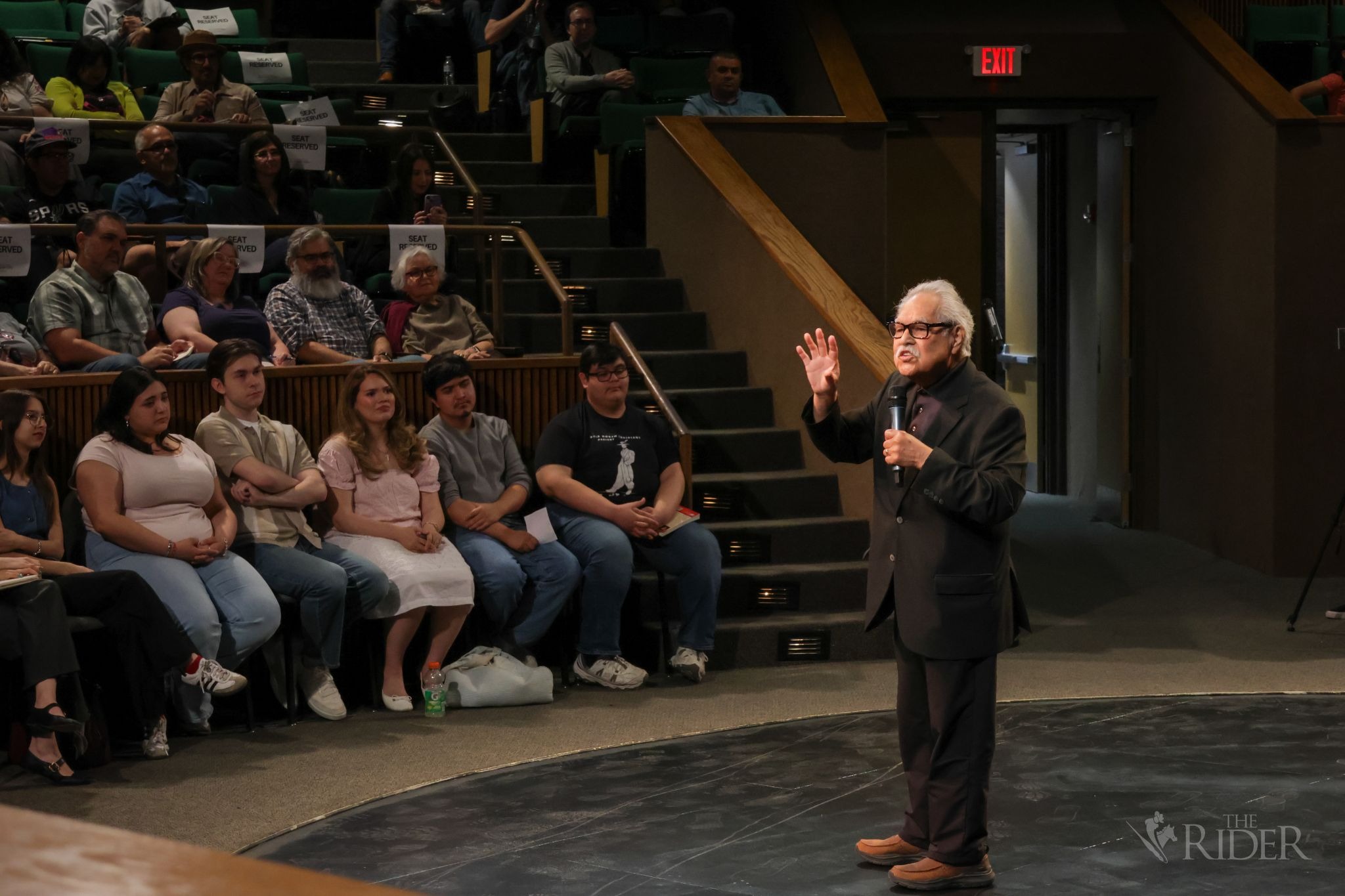
The UTRGV Theatre Department and Latino Theatre Initiatives hosted Theatre and Film Today at the Confluence of Mexico and the United States, a free public talk featuring playwright Luis Valdez.
The event took place Tuesday in the Albert L. Jeffers Theatre on the Edinburg campus.
Standing before the campus audience, Valdez did not begin his speech with theory or credentials. Instead, he told a story.
He recounted arriving in South Texas in the late 1960s, traveling overnight from California with fellow performers during the farmworker movement led by César Chávez. Somewhere along the highway, their packed station wagon hit a skunk. The smell forced them to stop, delaying their trip to Rio Grande City, where they were scheduled to perform.
By the time they arrived, hours late to their performance and exhausted, they expected an empty venue. Instead, they found a crowd on a dark street expectantly waiting for them.
“They had waited an extra hour,” Valdez said, when describing how residents helped unload props and pushed the group straight onto the stage after nearly 24 hours on the road. “The enthusiasm … was incredible.”
He had never been in Texas then, but that moment, he said, shaped his introduction to the Rio Grande Valley. He said it felt “like home.”
Valdez, founder of El Teatro Campesino in California, has spent more than six decades using theater to tell the stories of farmworkers and Mexican Americans. He described how his work began with simple performances, such as short, improvised plays staged on flatbed trucks during labor strikes, and grew into a broader movement that helped define Chicano theater.
He is best known for his play “Zoot Suit,” following the story of Henry Reyna and his gang, who are unjustly convicted of murder, facing racial prejudice before ultimately winning their appeal and freedom, and his movie “La Bamba,” showcasing the rise of 17-year-old Mexican-American Ritchie Valens from farm laborer to 1950s rock and roll stardom.
Despite being the first person to professionally produce a Chicano play on Broadway, Valdez’s message to students was less about his legacy and more about their potential.
“The arts are very empowering,” he said. “Without the arts, there would be no Chicano movement.”
He encouraged aspiring writers and performers to tell their own stories, especially those navigating their identities across languages and cultures. For Valdez, that meant embracing both English and Spanish in his work to reflect the reality of Chicano life.
He also spoke about challenges, such as racism, rejection and the difficulty of breaking into spaces like Broadway. He recalled early criticism of his work and moments when institutions were not ready to accept Chicano stories.
“You can’t let people determine your own vision of yourself,” Valdez said. “Give yourself permission to succeed, give yourself to be who you are with your talents. It begins there.”
Beyond theater, he spoke on broader themes of immigration, identity and what it means to be American. He described the border not just as a physical line, but as something carried by people across the country, a shared experience that shapes culture far beyond Texas.
Valdez spoke about the blending of cultures over centuries, the evolution of identity in the U.S. and the importance of recognizing shared experiences. For him, storytelling, especially through theater, is a way to bridge those divides.
“It’s not the product, it’s the process,” he said. “The process of making art is a humanizing process. … You do it because it’s a way of life, because it gives meaning to your life.”
Christian Guzman, a management sophomore, was introduced to Valdez’s work through performing “Zoot Suit” in his senior year of high school, a “life-changing” experience for him.
“He made me think of so … much stuff that I didn’t know about, like how we were brought up, like the [Aztecs] and everything,” Guzman said. “It was … motivational. He basically said: Don’t give up on your dreams, even if you’re Chicano. Even if there’s not as many opportunities, you can still do it.”
After having the opportunity to perform for Valdez earlier in the day as part of a class, Diego Sifuentes, a theatre arts senior, was motivated to listen to his talk to hear more.
“Luiz Valdez is a literal legend,” Sifuentes said. “… Many people, if not everybody who knows theater, knows his name. I was like, I need to see this guy speak for another hour. It really exceeded my expectations.”
His biggest takeaway from the speech was Valdez’s focus on self-understanding.
“One of the things that stuck with me the most is how, as artists, as people, we have to know our hearts … we have to know who we are,” Sifuentes said. “I think that’s so important because it’s not something that’s just a theater arts thing. I think it’s a lesson. We are all lost at one point. We don’t know that we’re lost. We just kind of live life just so. He just gave us a reminder that we do need to find ourselves because we don’t always know who we are.”
After a Q&A session, the event came to a close. Valdez left the audience with a message not to wait for conditions to be perfect.
“Start with what you have,” he said. “Work with what you have. God has given you imagination, has given you a heart, has given you a body and [has] given you a voice. Use it. Use it to empower yourself and to empower.”
About The Author