

Eduardo Escamilla/THE RIDER
For many, healing is an inherited calling, a spiritual gift nurtured and developed. The folk tradition, known as curanderismo, remains a vital lifeline in Mexican American communities where healing is not just a science–it is deeply personal art, according to experts.
In a presentation Oct. 22 in the McAllen Public Library, Servando Z. Hinojosa, a UTRGV professor of anthropology, explored the blend of spiritual, herbal and cultural practices that define this system and the economic realities that keep it relevant today.
Hinojosa illuminated the diverse healing practices that have sustained communities for generations, including spiritists, herbalists, midwives and mentalists.
He said the healing practice is characterized by the work of curanderos and curanderas whose knowledge is not acquired through formal training.
The anthropologist said the healer’s work “arises from a more personal place, many would say, from a more divine place, but certainly one grounded in experience.”

Eduardo Escamilla/THE RIDER
During his lecture, Hinojosa emphasized the importance of these traditional healers, particularly in regions with high uninsured populations. He added economic and cultural barriers to formal care necessitate the continued reliance on folk healing.
Citing 2022 U.S. Census Bureau numbers, he presented to audience members that Hidalgo County, one of the four Texas counties making up the lower Rio Grande Valley, has an uninsurance rate of about 32 or 33% for people under age 65.
In a scenario where one out of three people lacks health insurance, seeking a physician or clinic is difficult, forcing people to “make hard economic choices.”
The professor also noted people may fear linguistic misunderstanding with a physician, rebuke for discussing folk conditions like mal de ojo or empacho, or legal consequences of going to a public facility.
“Is it any surprise that people look for care in other than formal ways, and other than formal channels, like, the kinds of caregivers that we’re talking about [curanderismo] that never judge?” Hinojosa asked the audience rhetorically.

Eduardo Escamilla/THE RIDER
Ave Espiritual Yerberia and Spiritual Shop, located at 700 E. University Dr. in Edinburg, is a building which owner Minnie Ave claims has stood for 100 years, where she has provided spiritual healing through the practice of curanderismo for 28 years.
She said she sees her shop not merely as a business but as a “library of information” and a new-age pharmacy, striving to connect people back to natural healing methods and their spiritual roots.
Ave added she believes anyone can develop the gift of healing, or the “don,” which is “in us all.”
While she acknowledges that all folk-healing aspects are intertwined, her primary focus remains on cleansings, also known as limpias.
She said the daily accumulation of “worry, stress, frustrations” builds up a “heaviness” or “negative energy” in a person, which eventually repels positive energy.
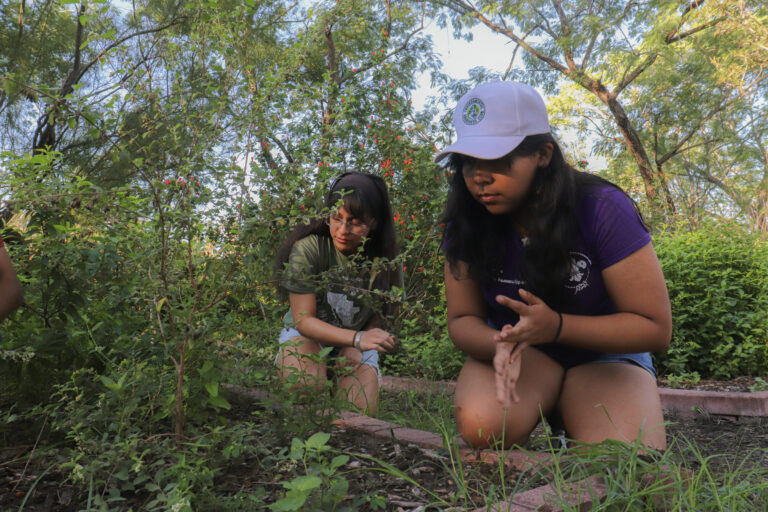
In her cleansing process, Ave said she uses her personal, neutral energy along with fresh herbs, projecting her energy to act as a “jumpstart” for a “drained battery,” helping to release the heaviness and make the client’s energy flow.

Eduardo Escamilla/THE RIDER
Ave said the result is a sensation of relief, with one client comparing it to taking off a “heavy backpack.”
The No. 1 reason her clients seek spiritual healing is the desperate need for peace, according to her. When clients are under “stress … and duress,” her cleansings and card readings aim to provide validation to help them move forward.
In the folk setting, Hinojosa said he prefers the term client over patient because it reflects a person’s “active health seeking and decision making.” Many clients are not abandoning formal medicine; instead, they are “active agents” who may be concurrently seeing clinicians but “feel that there is more that can be done for them as health seekers.”

Eduardo Escamilla/THE RIDER
About The Author