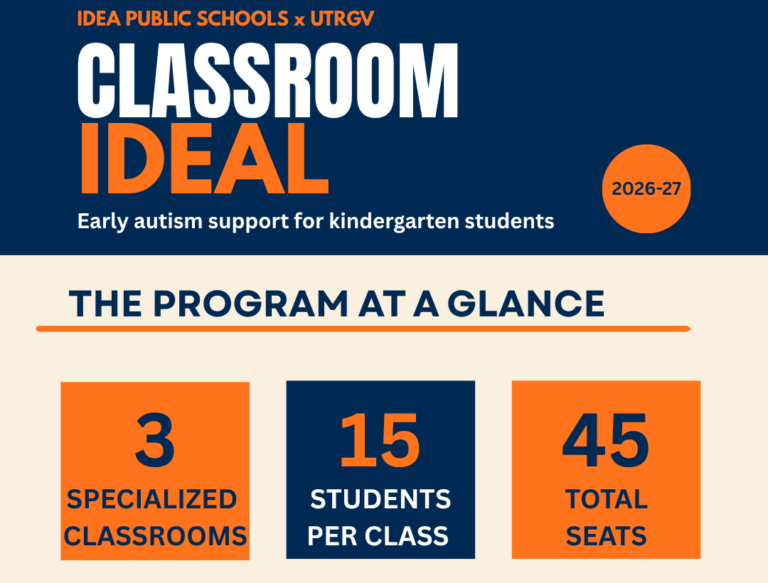

IDEA Public Schools, in collaboration with UTRGV, launched its first year of Classroom IDEAL on Aug. 17, an early intervention program for kindergarten students with autism.
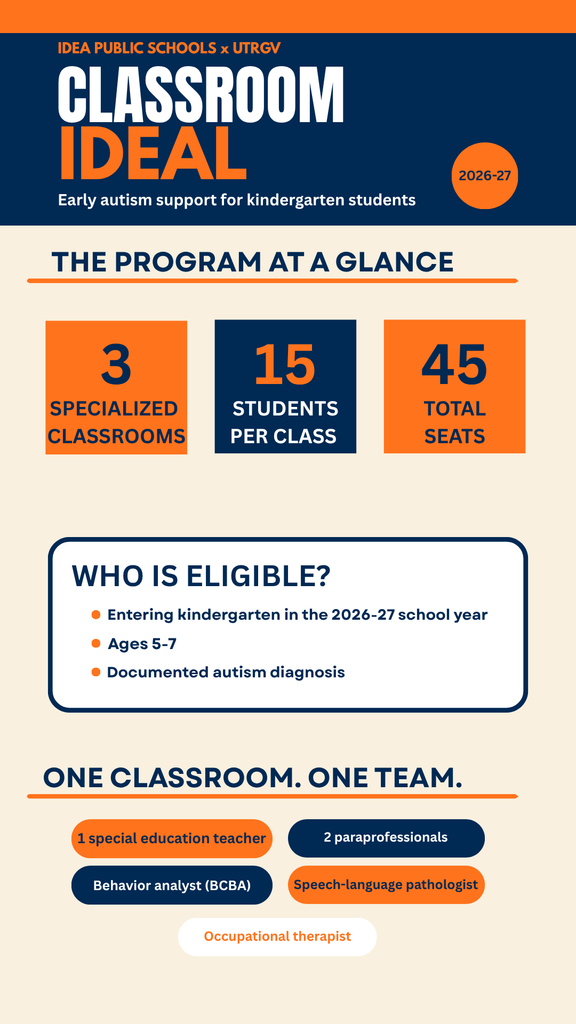
The program serves students ages 5 to 7 and currently has 32 students,with a capacity of 45, according to IDEA Public Schools’ website and Blanca Garza, senior principal at IDEA Quest Academy.
Classroom IDEAL has three specialized classrooms with a capacity of 15 students each. According to IDEA Public Schools’ website, each classroom has a special education teacher, two assistants, a board-certified behavior analyst, an occupational therapist and a speech-language pathologist.
Garza said students enrolled in the program still receive the same curriculum and instruction as their peers, with accommodations based on their individual needs.
“They’re receiving instruction just like any other student would, but we are accommodating to their needs based off of if they already come with the IEP or being placed in other programs to provide accommodation and support to meet both academic need and need through services of the therapy,” she said.
Garza said students’ participation in general education classes and activities depends on their diagnoses and evaluations. The program’s ultimate goal is to transition students into general education classrooms with the support of early intervention services.
Staffing additions and rotations depend on students’ needs, she said.
Noe Ramos, associate professor and School Psychology coordinator at UTRGV, said research emphasizes the importance of early intervention, regarding why the program was directed at kindergarten students.
Ramos said the program aids to provide frequent and high-quality assistance beyond the minimum services required by law to help students make “exponential growth.”
Program staff members are paid through UTRGV and rotate among three classrooms, Ramos said. Two registered behavior technicians support the board-certified behavior analyst.
The program is funded through a grant-supported partnership with UTRGV, and there is currently no cost to participate, according to IDEA Public Schools’ website.
“We were fortunate enough to receive three grants from the Texas Higher Education Coordinating Board in relation to serving our autism community here in the Rio Grande Valley,” Ramos said. “One is $1 million,” and “other one is … parent-directed … like $500,000, and the teacher one is about $400,000 … it’s close to $2 million for all three.”
Ramos said the grants operate on a two-year cycle, and the program plans to apply for additional funding when eligible.
Garza said enrollment applications require the same documents needed for other students to enroll a child in school, along with a medical diagnosis of autism.
Regarding opportunities for UTRGV students or trainees to work with the program, Ramos said the possibility could be explored.
Garza said future involvement would depend on screening and security requirements for anyone working in classrooms with students.
Debany Sarmiento, a psychology junior, said the program could create opportunities for children with autism who might attend school without receiving therapy services.
Sarmiento, who is studying to become a registered behavior technician, said working with students in the program could provide practical experience.
“I’m studying to be an RBT so … it would… help me,” she said.
About The Author